

Kate told me that I couldn’t get a whole column out of this, but before we get to today’s questions I want to address the young men of America on the subject of buttoning your top button and wearing a necktie: If this is uncomfortable, that’s because your shirt doesn’t fit.
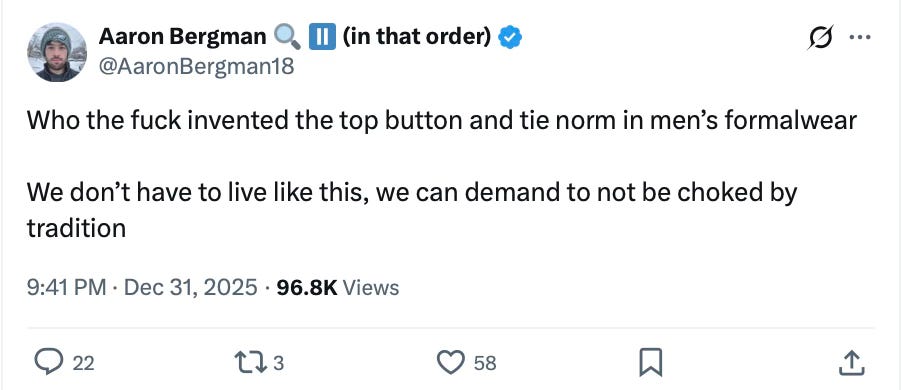
It is annoying that simple S/M/L/XL sizing makes it kind of a crapshoot as to whether any given dress shirt will have appropriate length sleeves for your arms and fit your midsection and also your neck.
But if you go to Brooks Brothers or Charles Tyrwhitt (just to name two stores that exist in most cities), they size their shirts with separate neck and arm lengths, and you can get one that fits. Or you can go to Proper Cloth or another “made to measure” place where they’ll sell you a shirt that fits exactly. Unfortunately, all of these options are a little more expensive than what you’ll pay for a shirt that doesn’t fit. But you either don’t need to wear a tie very often, in which case getting one shirt that fits is not a major investment, or else you do need to wear a tie frequently, in which case you shouldn’t be uncomfortable all the time.
Thank you for your attention to this matter.
lindamc: I read and listen to a lot of SB-adjacent stuff and I noticed that, at the end of 2025, quite a few take slingers (for example, those on Josh Barro’s new podcast and a couple of UK/European substackers) expressed optimism for the next year. This made me feel good! Then I read your intro to last Friday’s mailbag.
As a very logical person, how do you think of optimism? Is it an irrational way to view the world, even when things seem to be going pretty badly? Can/should its adaptive function outweigh this kind of downside? Do *you* feel at all optimistic about 2026 (in a general, not strictly electoral, sense)?
Here’s last Friday’s mailbag, for reference. I don’t think of myself as a pessimistic person or a doomer. I like to talk about positive trends in the world and try to stay focused on opportunities to make progress and improve things. In general, I think there’s too much negativity and rage-bait out there.
But as a political analysis, it seems to me that the American center-left keeps making mistakes born of complacency and hubris.
When Barack Obama used to invoke the line about how the moral arc of the universe bends toward justice, he was mostly trying to counsel patience, determination, and hard work. But what set in during his second term was a sense of demographic inevitability and efforts on the part of activists to front-run the pace of moral progress rather than actually convince people. And I worry a lot about the hubris that sets in when people look at how Trump’s numbers are down and Democrats are probably going to have a good midterm. Or when they persuade themselves that it’s obvious that JD Vance doesn’t have the charisma to hold the Trump coalition together.
I’m an optimist in the sense that I don’t think there is any huge structural force making it impossible for Democrats to pull this country out of the ditch. But for that to happen, people have to do the work and to inspire change you need to worry about the downside of failure.
disinterested: Interesting article I just encountered about the state of autonomous vehicles at the end of 2025.

They don’t get as much attention these days, perhaps because of the twofer of Waymo’s success with robotaxis and Tesla’s declining sales being the focus of news about that company. But this piece makes the argument that appearances to the contrary, neither Waymo nor Tesla have “solved” self-driving to the degree that their boosters would have you believe. In particular, it presents a lot of evidence that Waymo is intentionally obscuring the number of human operators involved with running the cars. Waymo has about as many employees as it has cars on the road, which you certainly would not expect for an autonomous vehicle company this many years along and in no way shape or form can scale.
The author makes the additional, and I think truly compelling, point that Waymo and Tesla are basically the only companies actually *working* on this right now. If self-driving was solved or nearly solved, why would that be the case? Why wouldn’t there be another feeding-frenzy of investment, especially since the economic case is so much more obviously compelling than that of generative AI?
Does this change your opinion at all on the potential for job disruption by AI? For me the takeaway is that with a lot of hand-holding and guardrails, AI can automate some easy but annoying tasks, but we’re a long ways away from anything approaching economically compelling uses.
I think that post starts with one claim — that pure self-driving cars are not a “solved problem” — but keeps edging into a different claim of dramatic skepticism about Waymo’s business prospects.