

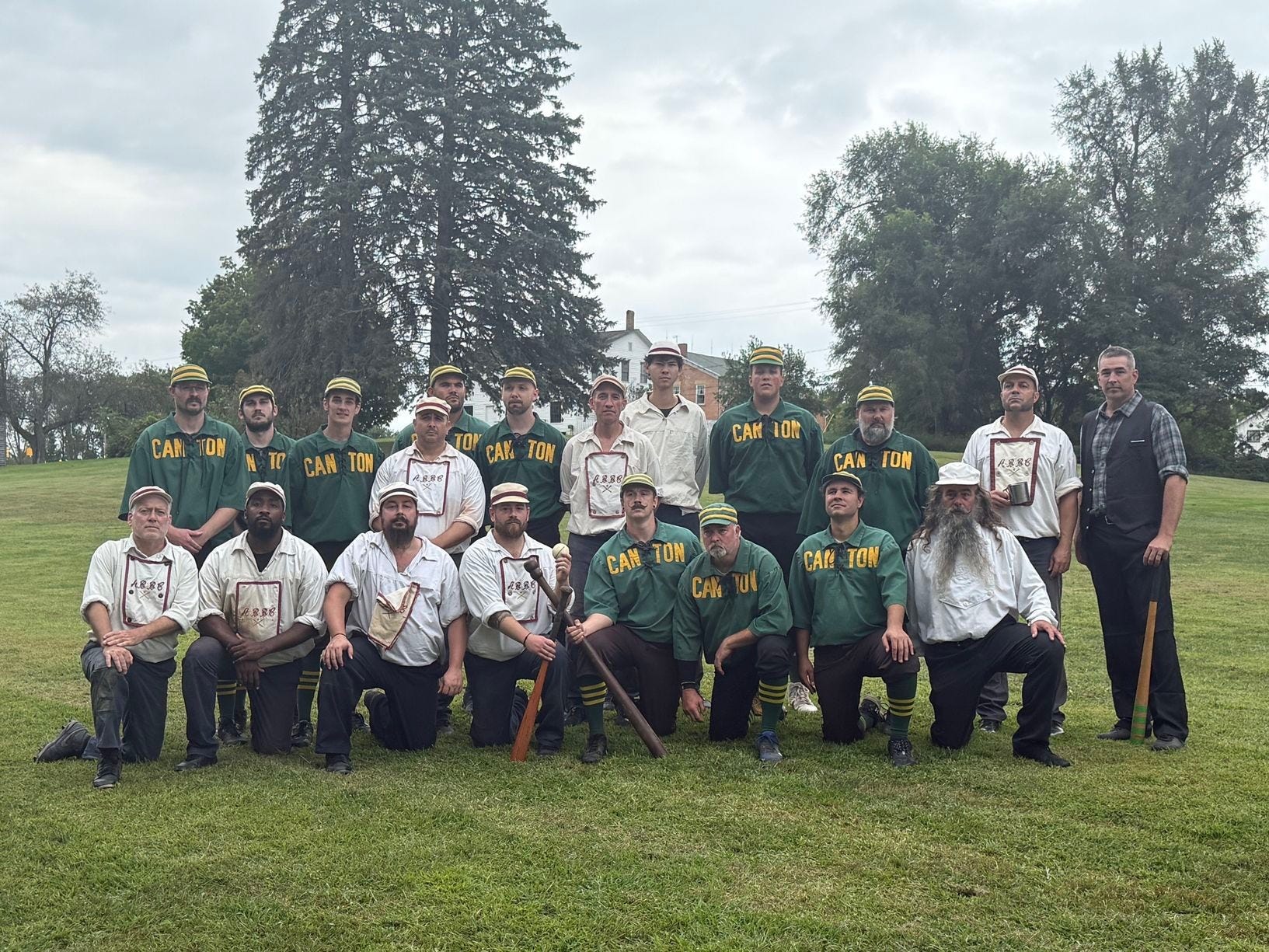
On any given Saturday in late spring, a man called Shakespeare will drive from Pennsylvania to New Jersey to play baseball.
He will travel about two hours in each direction, cross at least one bridge, and spend the better part of the day on a grass field in a uniform made by an Amish community in Indiana. He will play some 60 games without a glove before October. He will do all of this at age 64 as he did 30 years ago, and just as men did 162 years ago.
On one such spring afternoon in the mid-1990s, Frank Van Zant — “Shakespeare,” on the field — was walking with his children through the Old Bethpage Village Restoration on Long Island when he stumbled upon a game that looked something like the sport he knew. Having played baseball throughout much of his life, he had soured on the game because of his experience with adult recreation leagues.
It was vintage baseball, with its 19th-century rules, its throwback uniforms, and its curious fellowship, that made him fall in love with the game all over again.
That intrigue, shared by hundreds of players across the country, leads to the same place: a loose, growing confederation of more than 120 clubs playing baseball the way it was done before the sport calcified into the institution we’re all familiar with today. In vintage baseball, there are no batting analytics, no radar guns, and no replay reviews.
“It’s so much better than regular baseball,” Steven “Scarecrow” Cruz, who will be 37 on Saturday, said. “It’s more challenging. Not having a glove is completely insane but fun at the same time.”
Once a professional wrestler, Scarecrow said that he has been far more roughed up on the field than on the mat. In his 11 years playing vintage baseball, he has broken just about every finger on both his hands and ripped the webbing between them.
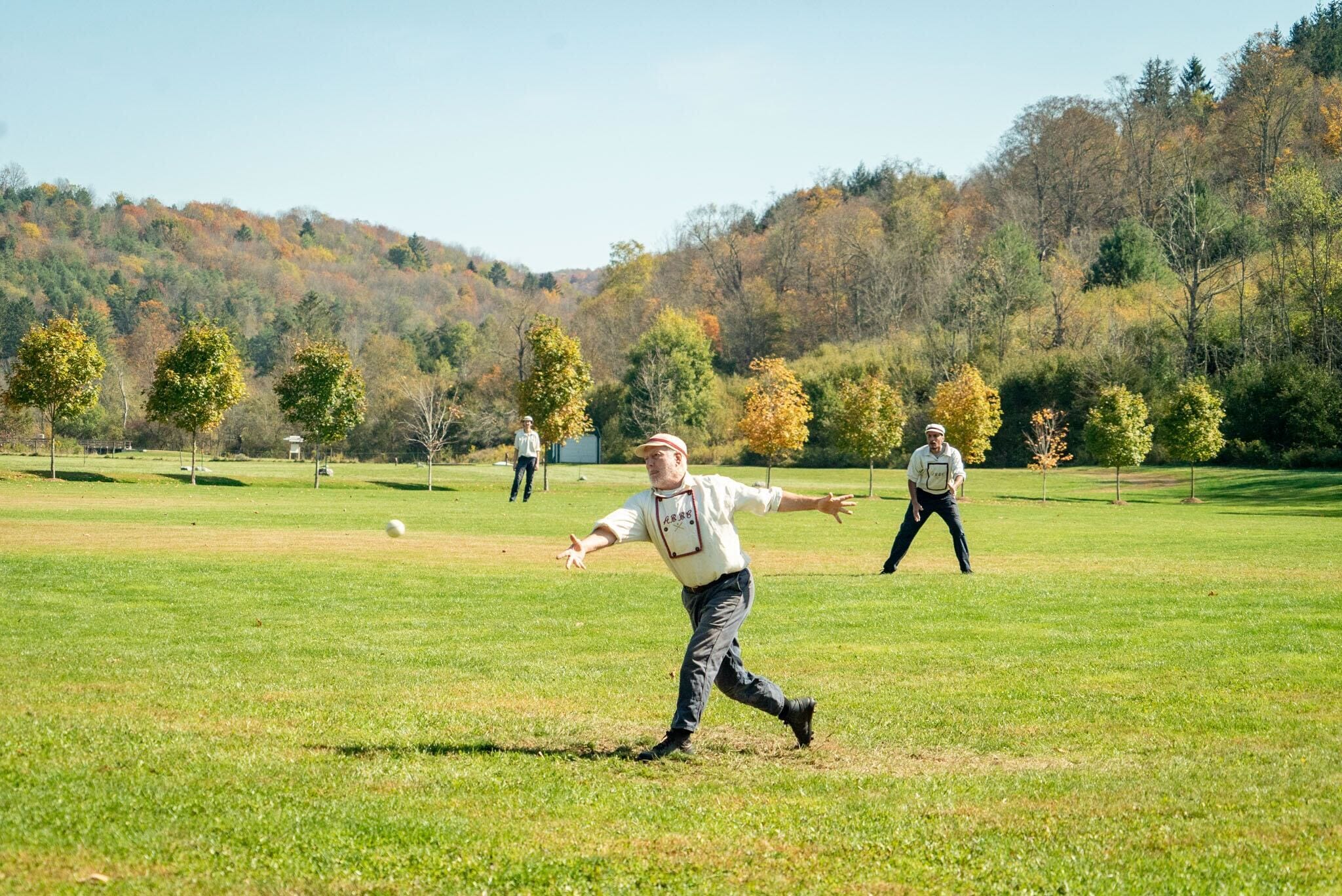
The umpire wears a three-piece suit, calls balls and strikes at his own discretion, and may choose not to call any pitches at all for a while if he doesn’t feel like it. If a batted ball bounces once and a fielder catches it bare-handed, the batter is out.
“We’re kind of like the Amish Mennonites of baseball,” Shakespeare told me. “No electrical scoreboards and rockets going off and things like that. The magic of it is that it calls up the days of horses and buggies and the farm fields where baseball was born.”
The Brooklyn Atlantics — Shakespeare and Scarecrow’s team — is one of the sport’s more storied franchises. The original Atlantic Base Ball Club of Brooklyn was organized in 1855, went undefeated in 1864, and was recognized as champions that year. In 1865, the Atlantics were, alongside the Washington Nationals, the first baseball team to visit the White House. The team was the precursor to the Brooklyn Dodgers and eventually the Los Angeles Dodgers.
The modern revival has been operating in its present form since around 2002. More than two decades later, some of the founders’ children have joined the roster. A few players have tattoos of the team logo, an honor that must be well-earned through on-field achievement and demonstration of one’s dedication to the game and each other.
“We’re a brotherhood,” Scarecrow said. “There’s nothing like it. We look out for each other, and we’re there to have fun. We’re also there to win.”
The game they’re playing
The rules of vintage baseball vary by era. Different clubs choose different years — 1864, 1884, 1896 — typically based on when the team they’re re-enacting was active.
The Brooklyn Atlantics play by 1864 “Beadles” rules, which are the most common standards on the East Coast and represent the earliest codified version of the sport. These rules are largely the work of a New York physician and player named Daniel Lucius “Doc” Adams, who is not in the Baseball Hall of Fame — a fact about which there is, among vintage baseball enthusiasts, considerable agitation.
The one-bounce rule in particular changes the entire tenor of the game. When a ball could be caught after bouncing once, players weren’t trying to hit towering fly balls. Instead, they were trying to place the ball strategically, because an outfielder can let it drop and still get their opponent out. This produces, by all accounts, a faster, scrappier, more tactical style of play than the modern version.
It is also, Shakespeare explained, a style that was deliberately changed in an early version of the kind of game-smoothing optimization that all modern professional sports are undergoing.
In the winter of 1864, a group of New York captains met and voted to eliminate the one-bounce rule, which came from an even older set of rules — the Knickerbocker Rules of 1845. They found it unsatisfying that fielders were choosing not to catch balls in the air. From 1865 onward, if it hit the ground, you had to throw the runner out.
The Atlantics, purists as they are, still play by the pre-1865 version.
The people who play
The Brooklyn Atlantics are a roster of Long Islanders and Brooklynites. Their players are construction workers and teachers. Scarecrow is a driver for FedEx. The median age falls somewhere between 40 and 50. The team’s oldest player, 65-year-old Wild Horse, is just a few months Shakespeare’s senior and says this will be his final season.
On the other end of the bench is the team’s youngest player, 26-year-old Dean Gordon — “Splash” — from Los Angeles, who moved to New York a few years ago.
“One of my big life passions is history,” he said, explaining his reasons for joining the team. “I get obsessed with reading about history and learning history.”
He describes his teammates with affection and bemused accuracy. “As you might imagine, the people who join and do this sort of thing are, like, super weird. They’re weird guys for sure, and gals,” he said. “They’re the best.”
He got his nickname last summer in Ohio.
The field had a pond in left-center, reachable only by a truly big hitter. The opposing team had such a hitter, and he sent the ball flying. Gordon, playing the outfield, went running and dove full-extension directly into the water. The home team, following tradition, stood up and sang a song in praise of the young, soggy outfielder.
The home team got a home run, and Dean Gordon became Splash.

Shakespeare’s own nickname has a gentler origin. His friend Robert “Bob” Harrison, the father of a player who was then a teenager, was himself a poet. He invited Van Zant to his first vintage game and on the spot declared that a poet’s vintage name could only be Shakespeare. Bob Harrison died in 2024.
His son Flash — now himself a father, the team’s webmaster, and a towering first baseman — still plays.
The roster is about 25 to 26 men (and sometimes women — one of the confederation’s only inaccuracies) drawn from all over, whose nicknames carry the history of the people who gave them. Shakespeare, who moved from New York last year, commutes from Pennsylvania.
“I’m not giving up my beloved Atlantics,” he said. “Luckily, I’m retired. I can do whatever the heck I want.”
The team travels as far as Ohio, Michigan, and Virginia. The commitment required is non-trivial — an away game means hours of driving, bridge tolls, and a full day given over to sweating in cotton uniforms under the summer sun.
“The guys who are making that investment really love it and are committed,” Shakespeare said. “They definitely are less assholeish than other guys who are showing up on a Wednesday night and drinking beer between innings. It’s a real community, vintage baseball.”
Rec leagues tend to be cutthroat, Shakespeare said. Players get benched for going hitless. People jockey for roster spots. There is a transactional quality to it, a sense that anyone who doesn’t perform is replaceable.
Vintage baseball, by contrast, runs on different logic. Conflict usually emerges as genuine disagreements about historical accuracy that function as a kind of ongoing scholarly debate. East Coast teams like the Atlantics play with stealing allowed, which Shakespeare says the research supports. Midwest teams often play by a modified rule that inhibits base-stealing — partly, it seems to Shakespeare, to keep scores down.
Shakespeare is polite but clear that this is historically inaccurate, and that the Midwest teams, when pushed, know it. When the Atlantics travel to the Midwest, they insist on their rules. Generally, they get their way.
“After all,” Shakespeare said, “we’ve invested the money to come out there.”
The point
As baseball keeps optimizing itself — the M.L.B. recently introduced robo umpires — toward some theoretically more perfect version of the game, what is preserved by refusing to follow along?
Shakespeare thinks of vintage baseball players as “the docents of baseball history.” They are putting on a re-enactment, showing audiences what the game looked like before it became a product.
But he also thinks that at the most basic level, the game is just more fun. More human.
A version of the sport where the ump wears a waistcoat and can call whatever he wants, where a fielder has to decide in a split second whether to let the ball bounce and make the easier play or go for it bare-handed, where a dive into a pond earns you a nickname you’ll carry for the rest of your playing life — that version has something the optimized version can’t offer.
“Every game to me is something special,” Scarecrow said. “When I’m out there on the field, I’m in my happy place. That’s all that matters to me.”
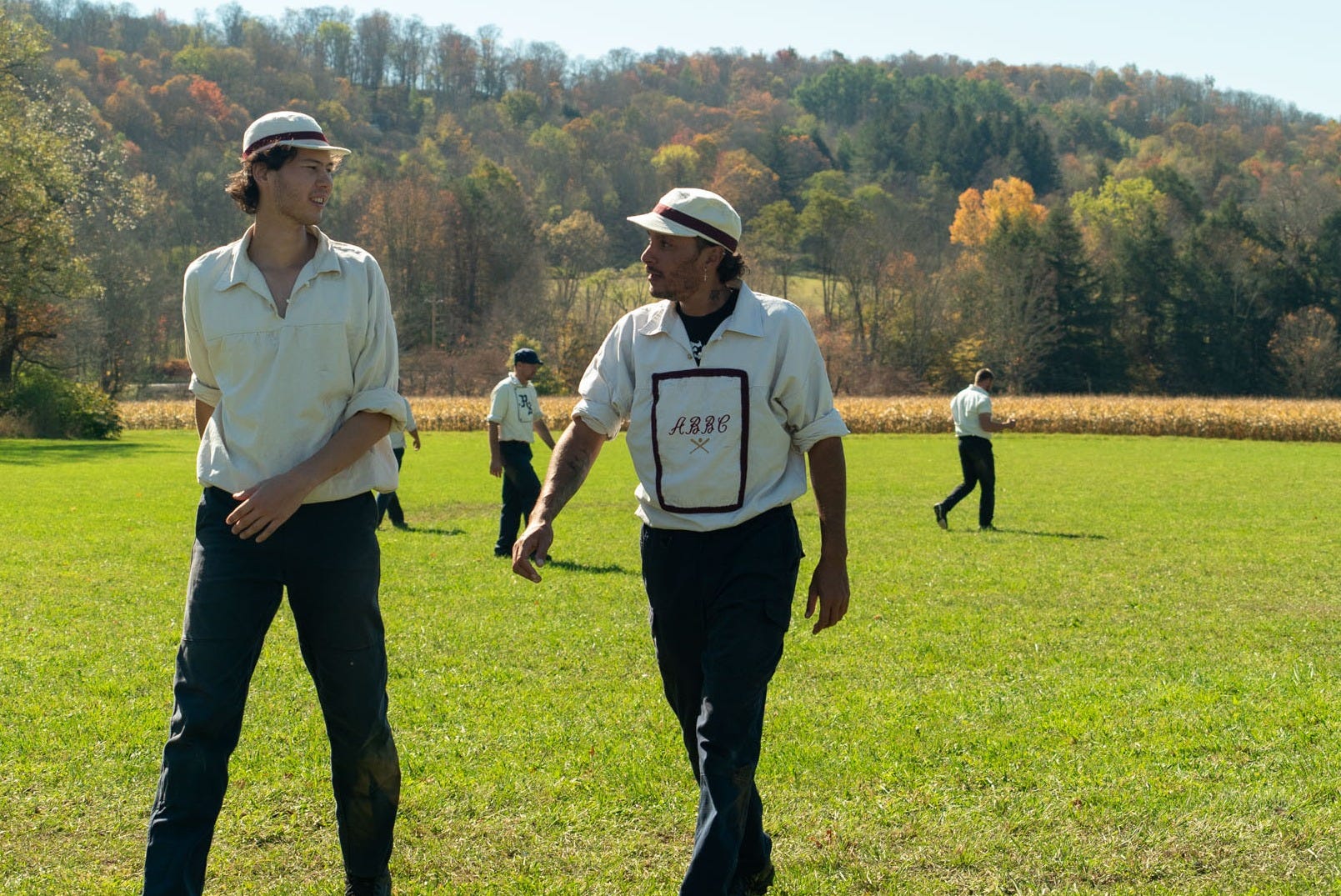
Splash, a recent liberal arts college graduate surrounded by middle-aged Long Islanders, puts it a different way.
Playing on a team that has existed, in some form, since the 1860s — that is connected to the actual Brooklyn Dodgers, to actual games played in actual Brooklyn, to a New York that no longer exists — makes him feel rooted in a city where he was recently a stranger.
“I’m part of something that was around almost 200 years ago,” Splash said. “That sense of connection is like lightning in a bottle.”
Weekend letter of recommendation:
Go to a baseball game. Perhaps a vintage baseball game in your area. But be careful — Scarecrow will make you play.
I am attending the Rockies -
AtlanticsDodgers game on Saturday.
Take a hike! I’ve been in Colorado this week and am absolutely loving my time outside.
Read “North Woods” by Daniel Mason.
Happy spring! Prepare your garden.
The content this week begins Monday morning with basketball, and ends Friday evening with baseball. Excellent work done, Slow Boring.
Fantastic journalism, Halina.