

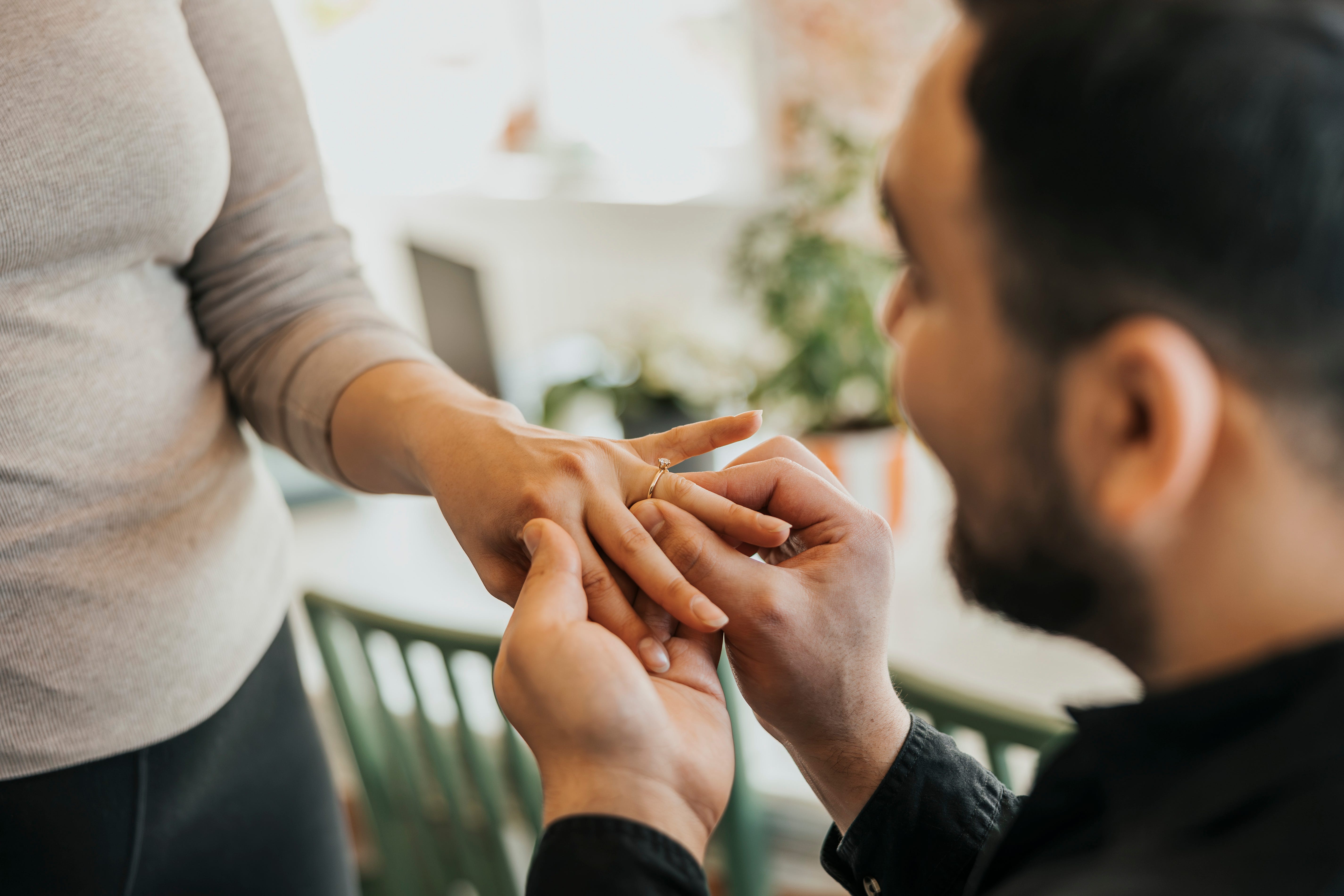
The oldest member of Gen Z is 29 years old. Despite the basically stable rate of college-educated women getting married over the last 100 years, there is a near-constant flood of think pieces online about why Gen Z isn’t marrying, the evidence that isn’t true, and warnings about what happens if young people don’t get their acts together and tie the knot. The data tells us that college-educated women are still marrying — they are just marrying later. It’s actually the numbers among non-college-educated women that are falling. Many of the people who will eventually marry simply haven’t reached the average age of marriage among college-educated women.
In March, Matt wrote that “yelling at ambitious young women won’t boost marriage.” His piece and the others he cites got me thinking about how highly educated young adults are actually approaching marriage.
I conducted interviews and sent a questionnaire to my network and their extended networks to gather responses from 112 people between the ages of 18 and 35. These people are mostly college-educated, and they are distributed across American cities of all sizes, from Ann Arbor to San Francisco, Brooklyn to Beaverton, and Austin to Salt Lake City. The survey was an attempt to hear, in their own words, what these young Americans actually think about marriage.1
What came back was not a portrait of disillusionment. Rather, the portrait that emerged was of a generation that has decided that marriage is worth having, and that value makes it worth waiting for.
The importance of marriage
Of the respondents, 83 percent rated marriage as a 7 or higher on a 10-point scale of personal importance. The median score was 8.
Some are skeptics. Sammy, 26, who lives with her partner of six years in Ypsilanti, Mich., rated marriage a 1 after she attended too many expensive weddings to sustain much enthusiasm. She also does not want to have children and sees marriage in that case as pointless. Abigail, 27, lives in Cincinnati with her girlfriend of five years, and gave it a 2. She also describes marriage as structurally unnecessary without children.
“Marriage just feels like an unnecessary prison,” Abigail wrote. “If something goes wrong like one of us having an affair, developing a gambling problem, etc., and neither of us are solely doing unpaid domestic labor, then what’s the benefit of all the strings attached?”
But Sammy and Abigail are outliers; the overwhelming majority who responded to the survey want the thing.
“There remains a romance in making a commitment to someone you love,” a 26-year-old Chicago man in a long-distance, long-term relationship wrote. “Marriage is an important milestone, and there’s inherent value in these points of demarcation in our lives that separate one stage from the other. As we get older, they’re fewer and farther between.”
The question, then, is more “when” than “whether.”
And on that question, this particular slice of young Americans has arrived at a near-consensus on the right time: From the ages of 28 through 32, once the career is established and the geography has settled, after the self feels adequately assembled.
The lack of urgency is not to be confused with indifference, though.
“In general I think the vibes are that there’s no rush,” wrote Jack, a 26-year-old who lives with his girlfriend of seven years in Denver. “But marriage is still viewed very positively.”
This view reflects a carefully constructed and socially promoted theory of the right order of operations for adulthood among the professional class. Marriage, in this schema, is the reward, not the foundation. Nearly all respondents laid out the same sequence in their answer for why they and their peers have not married yet: They need to finish school, establish a career, find their city, and then, and only then, they’ll commit.
“I want to be out of school, to have financial stability, to have put down the beginnings of roots in a city, and to have a few serious career years under my belt,” wrote one 24-year-old law student in a long-distance relationship.
When asked what is delaying marriage for them, respondents pointed to the same forces again and again:
79 percent cited a focus on career and personal development — by far the most commonly selected factor in the survey.
65 percent named financial instability or debt.
62 percent pointed to the erosion of social pressure.
More than half emphasized the desire to live together first.
Andrew, 28, who is engaged and lives in Beaverton, Ore., described the ideal moment as when both partners are “old enough to have an idea who [they] are and young enough that it’s more of a cornerstone than a capstone.”
The marriage tax
The financial dimension is a reason for delay among nearly two-thirds of respondents. One man in the South, who lives with his girlfriend of more than five years, described his “opposition to the spectacle of the wedding-industrial complex.” Sammy — one of the marriage skeptics — wrote that weddings, and everything associated with them — from bachelorette trips to dresses to hair and makeup — have become demands on other people’s money, and that the person getting married should absorb those costs themselves. A 30-year-old in Boston avoided the problem entirely by having a courthouse wedding that cost $500.
But the more structurally interesting obstacle is one that emerged among Gen X and has bloomed since: geography. Gen Z, the children of the generation who set off the trend, move more frequently than any other, having scattered to different cities for college and graduate programs and first jobs, and have discovered that the shape of an ambitious young life is not easily compatible with the shape of a shared one.
Julie, 24, is in medical school in New York while her boyfriend of six years is pursuing a doctorate elsewhere. “I want to make sure that our residency and graduate school paths align location-wise before we commit to getting married,” she said. Another woman, also in medical school, in Cambridge, noted something more counterintuitive: If she married now, her husband’s income would be counted in her financial aid calculation, reducing her package.
Even some who mixed marriage with graduate school found diverging ambitions as a barrier. One 26-year-old medical student married her husband in 2025 before starting school, knowing she and her husband would spend at least the first year and a half of marriage apart.
Josh, 27, who lives in Wisconsin, is engaged and planning a September wedding. He got to that milestone because his then-girlfriend made a sacrifice on employment to stay in the same city. He is clear-eyed about what that required and appropriately skeptical of the standard excuses. “I think career positioning is overrated,” he wrote. “But I also don’t work at a stereotypical company where promotions are required to get raises.”
He also pointed out that due to social media, members of Gen Z are more likely to compare themselves to their peers, influencers, and celebrities.
“Some of the stuff our parents have came over decades, whereas some people feel the pressure to get it now, when earnings are at your lowest,” he wrote. “I think the thing that helped me most towards proposing was not being on social media and feeling outside pressure on ‘what to do.’”
And, of course, decisions are informed by where respondents grew up and live now. Philip, who got married at 28 in the Northeast, said his peers felt it was an unusually young age to make the big leap. Kate, who grew up around mixed communities in Southern California, said that among Hispanic friends and family, she saw marriages at 18 to 22; in the white professional world she entered, late twenties to mid-thirties was the norm.
Austin, 33, is married. He and his wife met 10 years ago and got married after dating for six years. Now in Brooklyn but from the rural Midwest, Austin remarked on the clarity that comes from having lived in multiple worlds.
“We are from the rural Midwest where marriage norms are not as decayed as in San Francisco, Los Angeles, N.Y.C., and Boston,” he said.
Most of Austin’s former roommates and two of his three brothers are married. Among his Brooklyn peers, he said people express “a sincere desire for family and children,” but are “so terrified of having children and then getting financially rug-pulled that they delay the choice.” His conclusion, offered with some regret, was that the security they’re waiting for is largely illusory: “We should have just done it.”
Jack, in Denver, captured the social texture of his particular world that informs and reinforces attitudes toward marriage: “There is definitely some snide talk about people who get married ‘early,’ which at this point means before 25 or right after college.”
In certain zip codes and certain alumni networks, marrying young has come to register not as a charming traditionalism but as a mild social failure, as evidence that you didn’t have enough going on to wait.
In other groups, though, marriage says more about the relationship than the individual’s success. Taylor, who lives in Florida, married his wife in 2020 — about a year after she finished her undergraduate degree.
“I don’t think we ever considered the idea of not getting married after we had been together for a couple of years,” he said. “I don’t think anyone I know would think it was very strange to get married anywhere between 22 and 35; we do wonder why people we know who’ve been in a relationship 5+ years haven’t either gotten engaged or broken up.”
The girlboss who won’t wed
The years before marriage are understood as uniquely open — perhaps the only period of adult life when one can move freely, experiment, fail, and reinvent without negotiation.
Elise, a 24-year-old engineer in Denver, has been with her boyfriend for nearly five years, having known him for seven. She has no immediate plans for engagement. She loves her job, she told me, but she could also imagine quitting to travel, or to coach pickleball. The relationship works, she explained, because it does not constrain either of them.
“I do what I want,” she said. “We compromise to an extent, but if something really isn’t working for one person, I just don’t feel like the relationship works.”
Her boyfriend, she added, “absolutely would move in and do all that soon. I feel like I’m the stopping factor.”
This is the asymmetry that runs through the heterosexual couples in this survey. Women are more often the ones setting the pace, and they are setting it slower. Emily, a 28-year-old lawyer in Seattle, said that as the second woman in her family to attend college and the first to attend graduate school, she appreciates the relatively new opportunities for women outside of marriage and wants to take advantage of them.
“My grandmother got married right after high school,” she said. “She couldn’t even get a credit card without a husband. I’m not going to give up the chances she never had.”
Adam, 30, in Columbus, Ohio, is on the other side of this dynamic. His girlfriend of two and a half years “doesn’t feel comfortable getting married” while she’s in graduate school. He is waiting on her timeline.
Several respondents, unprompted, pointed to their mothers. Elise’s father died when she was six, and her mother never remarried. Growing up with a single mother who managed independently shifted her perspective, she said, toward asking what she actually wants in a life that does not have to center marriage.
One woman said that having divorced parents makes it harder to identify a good partner in the first place. To marry too young, in this view, is to risk stepping onto a conveyor belt that has a destination you cannot fully control.
What’s it all for?
And then there is the question of what marriage is actually for, a question to which most respondents answered with straightforward comments about the legal and financial case for a union: taxes, hospital visitation rights, inheritance, immigration status. Many also pointed to wanting to have children only once married.
Beyond logistics, the less straightforward reason that came up is what Jonathan, 24, who lives with his girlfriend of three and a half years in Ann Arbor, called it “social messaging” — a signal that a relationship is real. They want what one 29-year-old man articulated as “becoming a part of something bigger than you are if you’re just two people cohabiting.”
“You can’t just end it if you’re mildly dissatisfied with the way the relationship is going,” he wrote. “You’re committing to working it out.”
Austin framed it as a community act rather than a private one. “Marriage is not about the two of you, but rather about a public opt-in by everyone you care about to support your commitment to each other and your family.”
Another man in Michigan wrote that marriage means you’re “locked in,” before he hesitated. “I guess a marriage could just end, too.”
This is a generation that grew up with divorce as a background condition. Clare, 22, who is single and living in Dayton, Ohio, noted that many of her peers “grew up with divorced parents, so they might be less likely to marry young.” Abigail’s parents stayed together until she left for college, then separated and never divorced — living an hour apart in what she described as “at best, a platonic companionship.” And yet, even Abigail still assigned the institution a 2, not a 0.
For a generation that optimizes everything, marriage is the next logical thing
What holds so many of these people back is not, in the end, doubt — it is a habit of optimization. Philip, reflecting on his first year of marriage, wrote that his peers are waiting for “a magical switch that will go off in your head that says ‘I’m ready.’” It does not exist. “There is always going to be a degree of taking a leap of faith,” he wrote. A culture oriented toward certainty, he wrote, “dissuades that act of taking risks, especially with another person.”
This is a generation trained to wait for complete information — for the best option, the right moment, the optimal conditions. Marriage resists this habit because the data is never complete and the conditions never fully stabilize.
Some, looking back, recognize the trap. One 33-year-old man in Kansas City waited eight years to marry his now-wife. He now sees the delay as unnecessary. “At some point it felt like we had been married long before the actual ceremony,” he wrote.
A woman living in the Netherlands who married at 26, partly to secure an E.U. visa and simplify the legal architecture of buying a house and having children, offered the most pragmatic corrective: “You are still growing, and growing together, after you’re married,” she wrote. “In my mind, it’s a valuable commitment and legal protection that doesn’t stop you from doing any of the things that people give as wanting to put things off.”
In the end, these young Americans are not rejecting marriage en masse. They are pursuing it with deliberation and caution, waiting for the right city, the right job, the right financial footing, the right version of themselves. It is a reasonable approach to a big decision. It also, as the married respondents might tell you, has a way of going on forever.
“I read a line somewhere that, ‘If it’s the right person, it’s the right time,’” wrote a single, 25-year-old man. “I really think that’s true.”
This piece is based on an informal online survey of 112 respondents between the ages of 18 and 35, distributed through personal and professional networks, as well as several longer recorded conversations. The survey is not a representative sample of young Americans. These are opinions gathered from my Slow Boring and personal networks, with the survey having been distributed by my circles outward. Accordingly, respondents skew college-educated, geographically mobile, and concentrated in coastal and university cities. They are also mostly in relationships, which I attribute to people in long-term relationships having the most to say about marriage. Respondents who requested anonymity are not identified by name.
"This is a generation that grew up with divorce as a background condition."
Which has been the norm since Gen X was young. The US divorce rate peaked from 1979–1981. Gazeth Past Thy Navel.
Huge caveat with my comments. I married when I was 23 and have been married for over 30 years. We had our first kid after 9 years of marriage, at the end of grad school.
I 100% agree with this person in the article: "His conclusion, offered with some regret, was that the security they’re waiting for is largely illusory." Even in your 30s or 40s, your jobs might take you to different cities; a family member might become very sick and you move or leave your job to be with them; you might lose a job or have something financially devastating, like a fire, set you back; and on and on. I am old enough to know that these sorts of things are not particularly uncommon. Don't get married just for the heck of it, but if what you are waiting for stability, well, stop waiting and just do it. In a perfect world, I would have had kids younger than I did for the same reason.