

Back in November, the Department of Homeland Security put out an insane propaganda tweet asserting that immigrants are responsible for all the problems in American life, only to be met by a Pramila Jayapal retort that, actually, it’s all the fault of evil billionaires.
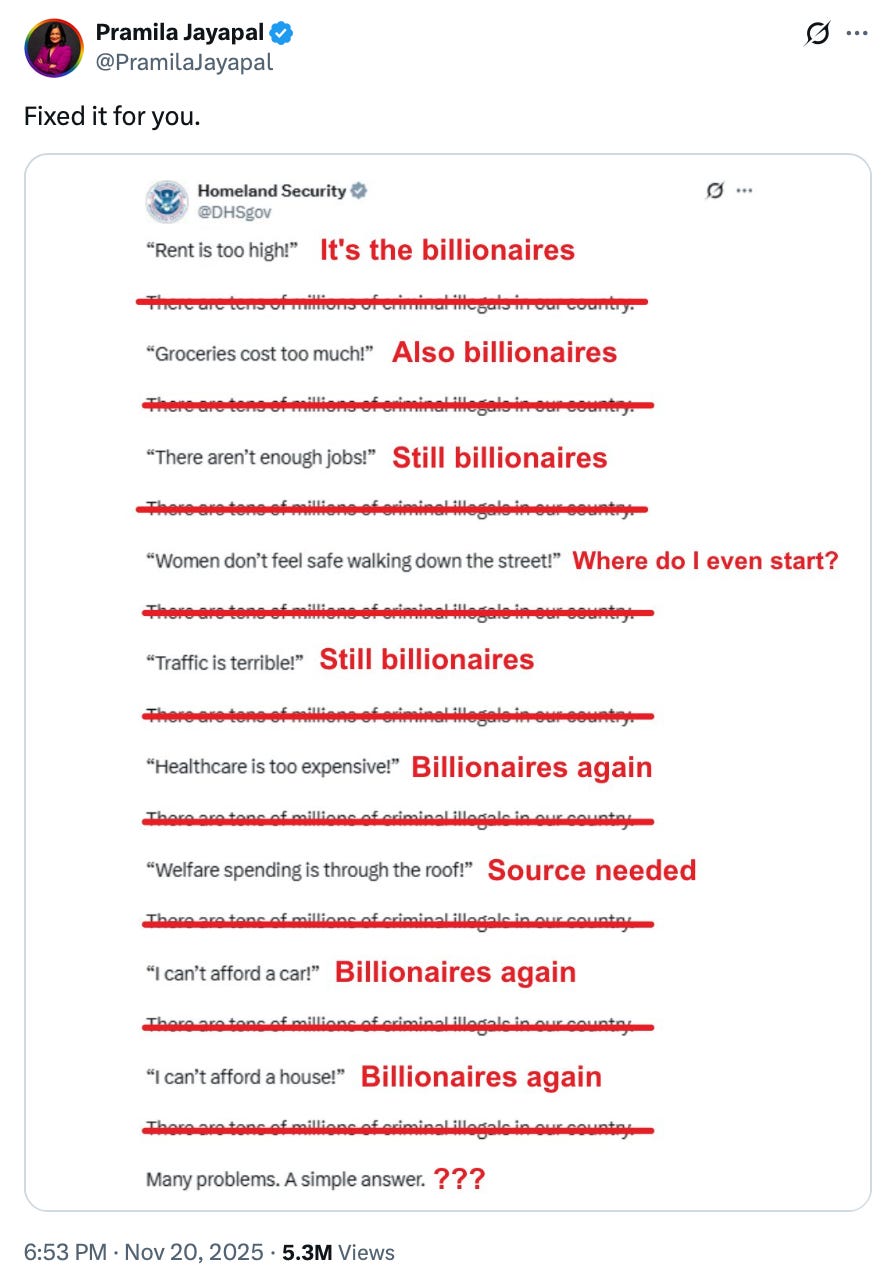
This is really dumb as a policy analysis.
Billionaires are not the reason that traffic is terrible, for example. They just aren’t. A lot of this is that Pramila Jayapal has incorrect ideas about economics, but I can’t even begin to reconstruct what she’s thinking about traffic jams. She’s suffering from Billionaire Derangement Syndrome every bit as much as Stephen Miller has gone ’round the bend with hatred of immigrants.
And, on some level, I empathize with her.
Social media has exposed many of us, often for the first time, to the casual political thinking of extremely high-net-worth individuals. And it’s truly aggravating to watch Bill Ackman or Marc Andreessen sound off in an ignorant way about various issues. Of course there are also lots of non-billionaires sounding off in ignorant ways too. But it’s more annoying when the billionaires do it because you can just imagine them sitting around smugly in their Scrooge McDuck moneypits firing off these bad takes without a care in the world, not even realizing that half the people agreeing with them are just kissing their asses because they are rich.
That being said, how many billionaires are actually out there firing off hot takes?
If you take a look at the Bloomberg Billionaires Index, you’ll find that the 500th richest person on the planet, Bruce Kovner (at the time of writing), has a net worth of approximately $7.4 billion. The list stops at 500, so there’s got to be hundreds more people with net worth below Kovner’s but above $1,000,000,000. How much do you know about them? Are they all obnoxious? I met Kovner once, and he’s not obnoxious. He’s more right-wing than I am, and I think too enamored of unregulated school choice. On the other hand, he supports Success Academy, which is a very good charter-school network, and also things like Juilliard and Lincoln Center and other uncontroversial arts stuff. Here’s one of his politics takes from a decade ago:
I believe in free-market principles and strong defense and look for those things in political representatives. In my view, complex coalitions lead to the most stable government, so I want a variety of opinions, ethnicities, and classes in each party. I deplore ad hominem attacks, which degrade the quality of political debate and are not good for the country. We can make progress if we call those who disagree with us our opponents in policy, but our colleagues in seeking good outcomes for America. But not if we call them dishonest or cast doubt on their good intentions.
That’s a pretty good take! Kovner pushed the R.N.C. to disavow Trump in 2016 and supported Chris Christie’s campaign in 2024. We could use more center-right billionaires with that level of integrity.
It feels a little absurd to write a pro-billionaire post, or do takes like “not all billionaires,” or say that some of the billionaires I’ve met over the years have been very thoughtful and perceptive people. I guess I don’t really think that anti-billionaire demagoguery is going to get out of hand and lead to blood in the streets and orgies of destruction.
But I do see people working themselves up, not about the details of tax policy or the regulation of any particular business, but about “billionaires” in general and I think it’s emotionally and intellectually unhealthy. There is nothing wrong with starting a business. There is nothing wrong with a business being successful. And it happens to be the case that if you start a business and it is very successful, you will end up with a net worth that is north of $1 billion. If you can pull that off, good for you!
Many billionaires are doing great things
I really got to thinking about billionaire positivity last summer when my family was in Maine.
Our town is sufficiently remote that we can’t get the fast Amazon shipping. In D.C., you can order a lot on Amazon for same-day or next-day delivery, and basically anything two-day delivery. Prime shipping has been with us so long and is so embedded into the fabric of my life that I don’t even think about it anymore. If I need something in the next day or two, I can just always order it off Amazon.
That is not the case in Hancock County.
Things might take a week to arrive! I was annoyed. And at first, I was annoyed at Amazon. I felt that Andy Jassy had wronged me personally by failing to organize speedy delivery to my particular remote slice of coastal Maine.
And then, of course, I read that a fulfillment center is set to open soon in Caribou and also that Amazon is seeking approval from the planning board to open another one in Gorham.
I started to get my head on straight.
Amazon is not the government; they do not actually have an obligation to offer their service everywhere in the country.
Amazon is trying to expand. They want to serve Maine better!
Amazon is beginning “what will likely be a lengthy process before the corporation can break ground on the facility.”
In other words, they are working hard to address my gripe with them and to an extent the public sector — or at least the planning board of Gorham — is standing in their way.
This is all really just to say that one of the main ways to become a billionaire is by offering products and services to the public at an appealing price. You’d miss these companies if they were gone. That’s in some ways especially striking when it comes to the billionaires who are also assholes. Elon Musk, for example, has for years now been using his public platform and wealth to promote pernicious political ideas. I think he has in meaningful and important ways become a bad person who is doing really bad things in the world.
But if you ask how he got so rich, it’s from Tesla and SpaceX and Starlink.
Unlike Amazon, I do not personally patronize any of those companies. But these are all clearly cases of useful products being provided to willing buyers at attractive prices.
In the case of SpaceX, it’s achieving some genuinely mission-critical things for the country. The difficulty that the other major European and American automakers have had making profitable electric cars underscores that Tesla’s achievements in this field are genuinely impressive, and Musk’s efforts in this sector have contributed significantly to addressing climate change. That’s what makes his behavior in the political realm so maddening. I wish he were not a tremendous asshole spreading demagoguery and hateful memes and destroying life-saving programs while generously backing Donald Trump. People should use their wealth and influence for good rather than for evil. But the act of actually building the wealth tends to involve good things and win-win transactions.
Billionaires don’t make you poor
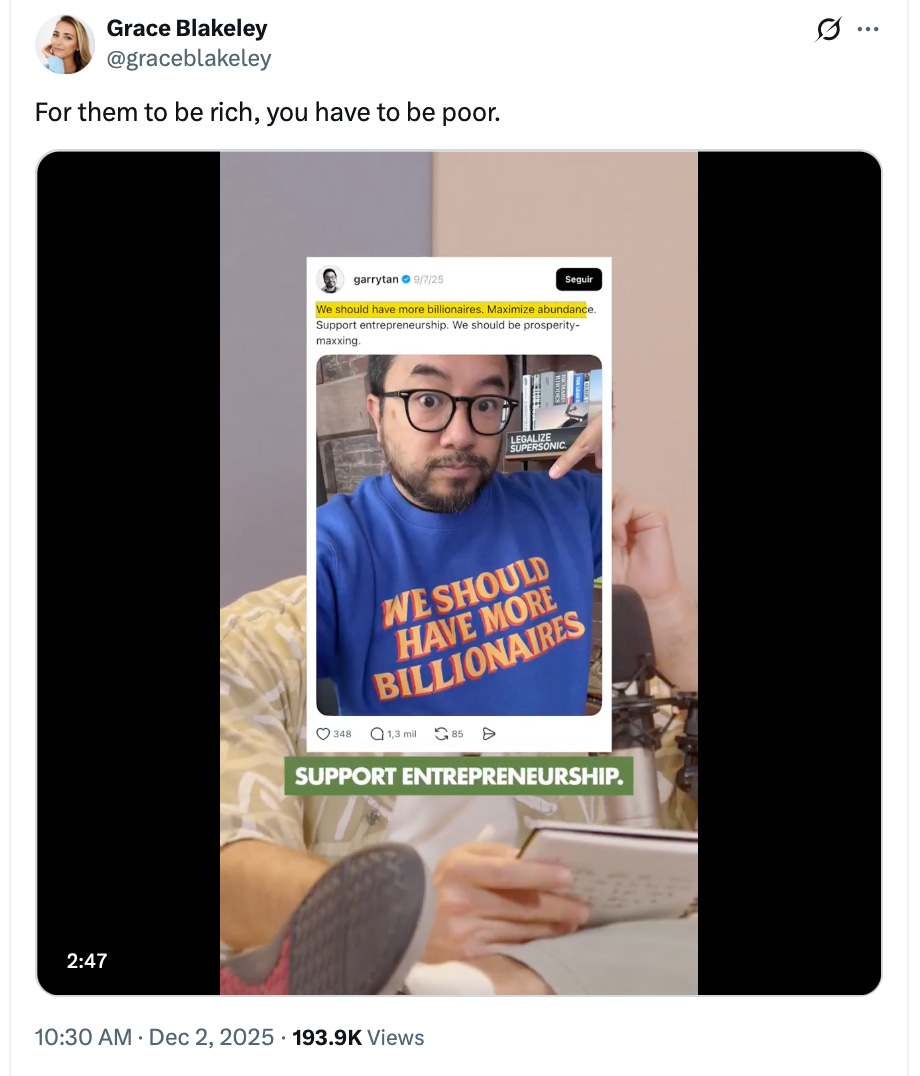
Grace Blakeley, who I guess is a Marxist influencer, said recently that billionaires are bad because their wealth comes at your expense. For them to be rich, she says, you have to be poor.
Jerusalem Demsas wrote earlier this month about the peasant logic of MAGA politics. And I wrote a couple of winter breaks ago about the Malthusian intuitions that drive anti-immigrant politics.
The point we’re both making is that for most of human existence life was, in most cases, basically zero-sum. Hunter-gatherers might obtain more prosperity for themselves by pushing some other group off of promising land. Later, empires rose and great wealth was obtained by ruling classes based on coercive extraction from agricultural laborers. Outright slavery was widespread, lesser conditions of unfree labor, like serfdom, keep popping up, and even ordinary taxation rarely involved the consent of the governed or any concept of the public interest. Into the 19th century, you can read about all these Jane Austen characters who inherited lands from their father and derive income wholly passively from renting it out to tenant farmers.
The modern economy just isn’t like this.
Land rents still exist, but they’re a much smaller part of the economy. The richest people in the world haven’t just appropriated some resource or confiscated income from the public — they are by and large making things that did not previously exist.
This doesn’t mean that market outcomes are perfectly fair. There are lots of winner-take-all outcomes and tipping points. It’s not as if the people behind the Google search engine were a million times smarter and harder-working than the people who tried to make Bing; it’s just that being a modest amount better and faster gives you a lead in users, which lets you win the whole market.
But this kind of critique of the role of luck and happenstance in delivering disproportionate rewards to certain people isn’t the same as a Malthusian economy in which the rich are getting rich by making you poor. The rich are getting rich by coming up with new stuff to sell to you.
Would you be richer today if Mark Zuckerberg had never been born? Almost certainly not. Now, if you happen to be Friendster founder Jonathan Abrams, maybe you would be richer today in a no-Zuck world. Maybe a lot richer.
But that’s just to say that billionaire wealth largely crowds out the opportunity for other people to become billionaires by dominating specific business niches that they were competing in. Karl Marx thought, based on observations that made a certain amount of sense in the mid-1800s, that “capitalists” were going to be like the landlords of the industrial era, ultimately reaping all the financial returns while the working class was stuck in growing misery.
This underestimated the dynamism of a technologically driven society. People in 2025 are a lot richer on average than people in 1975 or 1875 or 1825.
Really, the worst thing you can say about the billionaire class is that some of them, like Zuckerberg, are making money by providing stuff that people like but maybe is bad for us. It’s a little hard to know where to draw the line here, though. Obviously eating Sour Patch Kids is not good for you. Would the world be better off with no candy? We’d be healthier in some ways of course. But we’d also be missing out on something fun.
I do think there’s something worse about becoming a billionaire by selling people ad-supported infinite scroll than by selling people electric cars, and it’s a little annoying that Musk is so terrible politically while Zuckerberg has pretty sensible views. But even on the least-generous interpretation, it’s not the case that Zuckerberg’s wealth is coming at the expense of the average person.
Redistribution without insult
Okay, blah blah blah, but what about taxes?
This is a great point. I am a huge fan of taxes and a generous welfare state. Economic growth is not zero-sum, but it also isn’t automatically win-win. If you want a rising tide of growth to lift all boats, you need distributive institutions that ensure that takes place and provides material resources to the elderly, sick, disabled, and to poor kids.
And I think that a lot of people who either engage in anti-billionaire rhetoric or (more commonly) who just kind of watch it flying by without comment think of anti-billionaire-ism as bolstering a basic progressive tax agenda. But does it really?
For starters, anti-billionaire-ism gets the policy wrong. People sometimes debate things like “If California raises taxes, rich people will leave.”
I think this concern is empirically overstated and the main reason people leave California is housing scarcity, which ought to be fixed. But if you believe that billionaires are making other people poor or otherwise harming the world, then you might think that driving them out with tax policy is actually a good idea when in fact it is not.
The empirical issue about mobility needs to be taken seriously on its own merits, because the goal of taxes is to raise revenue to spend in useful ways, so you don’t want to do things that are counterproductive. By the same token, when I think about local housing issues in D.C., sometimes people say that building new luxury apartments won’t help with housing affordability. This is false, empirically. But even if it were true and all that happened is that new luxury apartments caused new groups of rich people to move to town, that would be good — they would be customers for local businesses and contribute to the local tax base.
But I also think it gets aspects of the politics wrong.
Some very wealthy people are either deeply opposed to paying higher taxes or else have right-wing views on non-economic topics, and those people are Republicans. But there are billionaires who are pro-choice, who feel bad for poor people, who find knuckle-dragging anti-vaccine morons alarming. People who are probably a lot like you.
These people are probably not thrilled with the idea of personally paying higher taxes, but you probably aren’t either. The good news is they have plenty of money and are willing, at the end of the day, to cough some of it up to help build a fairer society. These people are Democrats, which is good. If you are alarmed about the consolidation of large swathes of corporate America behind Donald Trump and the MAGA movement (and you should be), then you should have the courage to say that it’s good that some rich people are in fact Democrats. And contrary to myth, these rich Democrats are not demanding tax cuts.
What is true, though, is that they probably would prefer not to be slandered as the source of middle-class people’s economic woes. It’s one thing to say “Hey rich businessman with left-of-center views on some issues, I’m going to make you pay more taxes” and another thing entirely to say “Hey, I think your life’s work has no value and you are a parasite on society.”
That’s insulting.
And in big-picture political terms, it’s worth keeping in mind that most individual successful companies are more popular than politicians or political parties. Lots of people use their products and services and like them. There’s a strong case for redistributive taxation — because a billionaire isn’t going to miss the money and it could do a lot of good for poor kids — but it’s neither accurate nor constructive to frame that case in terms of moralized condemnations of successful people.
Housing costs are the big driver of out migration from California, true. But the state is fiscally dependent on income taxes from a tiny, rich slice of the population. The top 1% of taxpayers generate more than half of income taxes and income taxes are the largest source of revenue. State revenue fluctuates with capital gains, especially from IPOs. If dozens of the highest earners leave the state because of taxes it won’t matter to aggregate mobility statistics but it will to the state budget.
Background https://calmatters.org/explainers/the-open-secret-about-california-taxes/#:~:text=California's%20tax%20system%2C%20which%20relies%20heavily%20on,taxes%20or%20borrow%20money%20in%20a%20downturn.
Most of this column boils down to “Whether you’re a billionaire or not, we’re all simply people, just like you and me”. Which dodges lots of interesting topics. A couple are –
(1) Why is the wealth of high-net-worth individuals soaring much faster than other basic economic metrics? Should society do something about that? If so, what? …
(2) Does it affect the analysis that high-net-worth individuals spend a relatively tiny part of their wealth? What should happen to all this wealth when these folks die? How many generations of Musk family members could live comfortably off his current $650 billion? …
(3) Given (a) the USSCt holding that spending big money on elections is constitutionally-protect “free speech” and (b) a few wealthy guys owning the dominant sources of information, is it a good thing that these few now have such disproportionate impacts on our lives (separate and apart from whatever widgets we might have bought that made them wealthy)? …