

A debate has been raging on the internet between Paul Krugman (here, here, and here) and three European economists — Philippe Aghion, Antonin Bergeaud, and Luis Garicano — in which Krugman maintains that the conventional wisdom that America’s productivity has risen faster than Europe’s is mistaken. This all hinges on technical issues about the construction of purchasing power parities, but the debate is being waged with a level of emotionality and vehemence that suggests something more.
Nobody is quite saying it explicitly, but I think that Americans like to argue about “Europe” (a construct that of course flattens major differences between countries) primarily because it’s actually an argument about the United States.
There’s a sense that progressive Americans want to make our country more “like Europe” and that therefore if Europe is bad that says bad things about the progressive project, whereas if Europe is good that says good things about the project. Of course this involves huge handwaving oversimplifications, but I do think it basically captures what’s going on here.
Much of the territory this debate covers is well trod. But I realized it might be interesting to consider it from the perspective of a country that is almost universally seen as an economic success story: Poland.
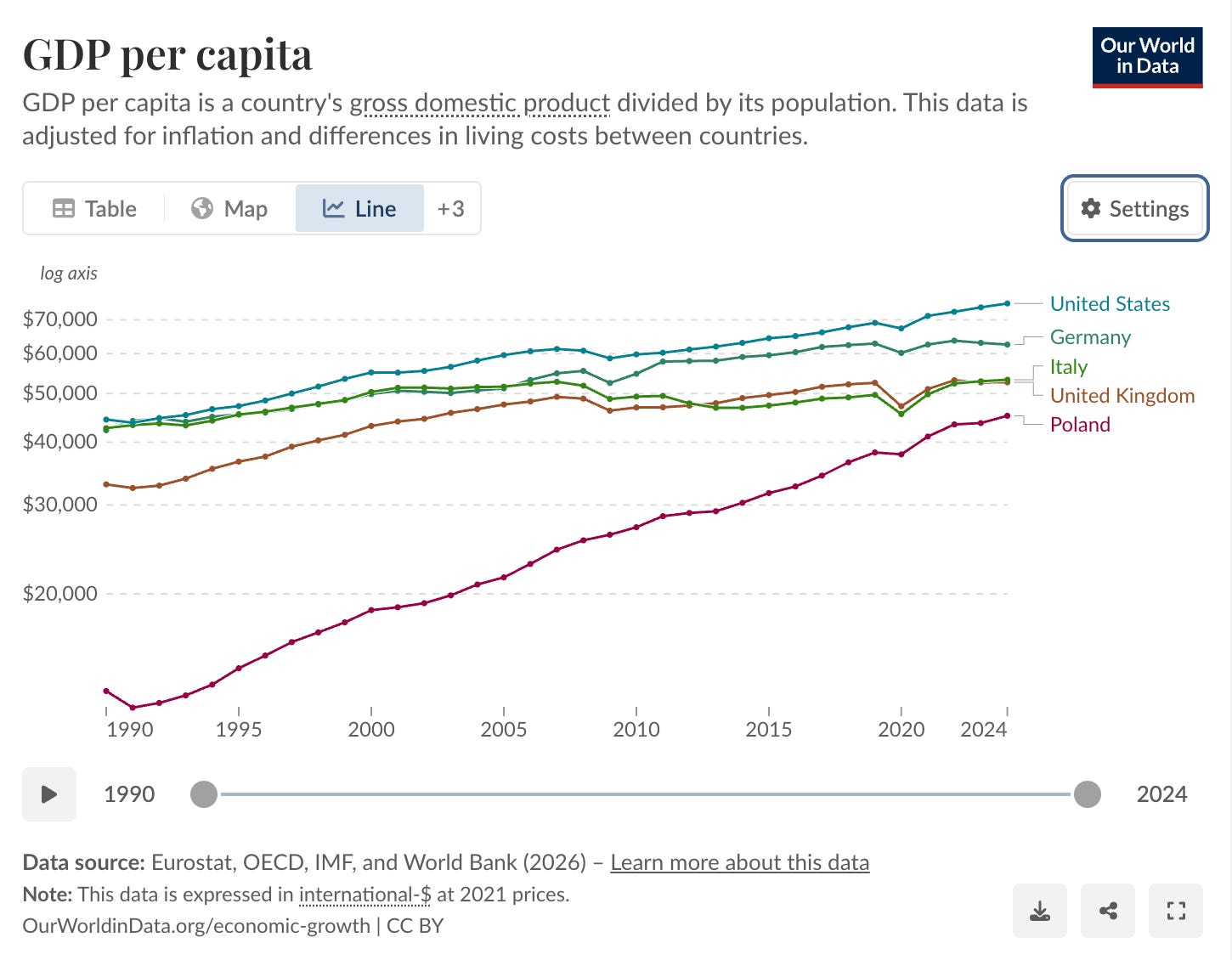
Poland was poorer than Western Europe dating back to well before World War II, and it then suffered for decades under Communist economic mismanagement and domination by the Soviet Union. But since the fall of the Berlin Wall, Poland has done extremely well. It’s not that Poland is suddenly the richest country in the world, but it’s growing more rapidly than the U.S., catching up to the global frontier, and threatening to soon leave stagnating countries like Italy and the United Kingdom in the dust.
Poland is an interesting development success story in part because it became rich through a model that always seemed like it should work according to a textbook but that in practice people rarely if ever saw. In fact, until recent years, it had become a bit of conventional wisdom that you actually couldn’t grow as rich as Poland has this way.
But Poland is also interesting because it poses the question of what are the stakes in this discourse exactly?
Conservatives are normally happy to acknowledge Poland as a success. The chart above tells an “up from Communism” kind of story, pregnant with implications for how prosperous Cuba might become if it ditched a failed economic model and embraced economic integration with the enormous and very rich country directly to its north.
And yet, insofar as “Europe” means anything in public policy terms, I think Poland definitely counts as part of “Europe.” Not just geographically, but in the sense that the main elements of the social model that American progressives like are present there.
Poland’s growth model
But first, the part of this story that I find most interesting.