

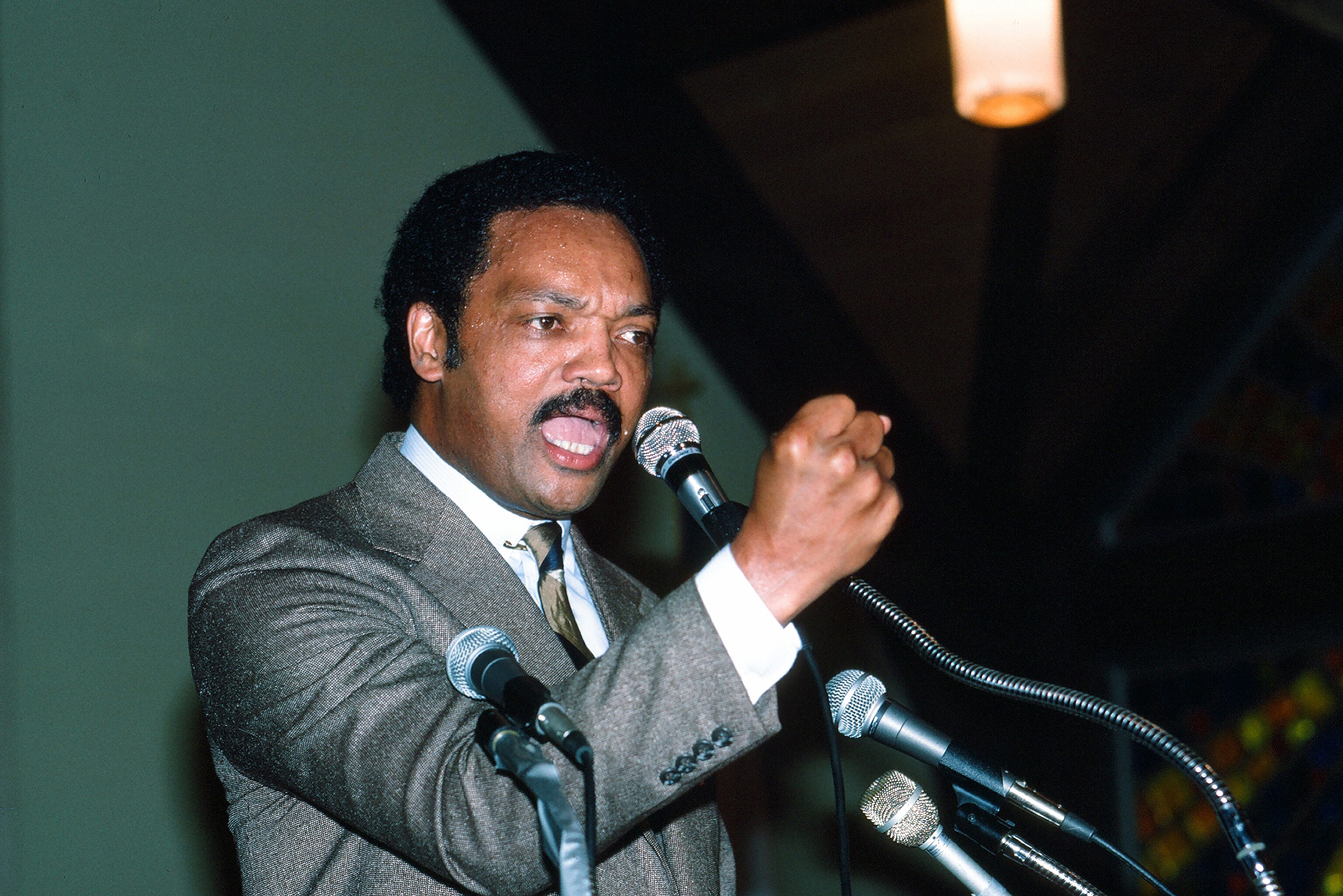
I wish I could say that I was old enough to have direct personal memories of the 1988 Democratic primary, because it was a fascinating moment in political history and my family — left-wing intellectuals on one side and Jewish liberals on the other — was very much at the center of dissension.
My home state of New York was essentially the Waterloo of Jesse Jackson’s primary campaign, where he ran into a solid wall of Jewish hostility led by ferocious attacks from the city’s then-Mayor Ed Koch.
The backstory is that in 1979 Jackson had flown to Beirut to meet with Yasir Arafat and P.L.O. leadership, which was an extremely spicy thing to do in the pre-Oslo days. And Black political leaders had long been conflicted as to whether they should follow the logic of a coalition logroll with liberal American Jews (who were largely friends to the civil rights movement and supporters of pluralism) or the logic of anti-colonial theory, which links Palestinian and Black liberation.
John Lewis’s 2002 op-ed about M.L.K.’s support for Israel and Hakeem Jeffries’s more recent reluctance to support Zohran Mamdani are examples of one approach; Jackson took the other.
This was a problem for him during his 1984 campaign, which led to an incident where he complained to an African-American reporter on background about the fact that “Hymies” (i.e., Jews) in “Hymietown” (i.e., New York City) were obsessed with Israel to the exclusion of other issues.
That information came out, along with questions about Jackson’s relationship to Louis Farrakhan, and became a huge issue for Jewish voters in the 1988 campaign. By that time Jackson had grown his base to include the kind of educated white voters who are today the backbone of progressive politics. But in New York a very large share of those white progressives are Jewish, so the perception that Jackson was antisemitic dealt his campaign a blow and helped crush his momentum.
Jackson was always apologetic about the slurs, and eventually ended his campaign with an iconic speech at the 1988 Democratic National Convention.
Jackson never pivoted to Lewis/Jeffries-style pro-Israel politics, but he did very successfully mend fences and build bridges with Jewish Democrats in subsequent years, earning lavish tributes upon his death from Rahm Emanuel and Chuck Schumer. That reflects his skill and hard work and determination to stay true to the moral core of his position on the issue, while also taking very seriously the idea that he’d made mistakes and would serve the cause better if he acted to correct them.
But that kind of praise also reflects the extent to which the arc of history has bent toward Jackson since that speech. Not so much on the specifics of Middle East policy, but in his conception of what the Democratic Party should be.
The “Goldwater moment” that didn’t happen
There was an idea, starting in the 1940s and 1950s, that the country should have two polarized, ideological political parties. Of course, it already had two parties. But the 1930s iteration of American politics featured many conservative Southern Democrats and many liberal reformist Republicans in the urban north. The idea that things should be sorted and coherent, rather than regionalized and messy, was controversial. But it ultimately carried the day.
On the right, this was signified by a handful of widely recognized events. There was the foundation of National Review in 1955 with the explicit thesis that free market Republicans should make common cause with Dixiecrats to forge a conservative movement. There was Barry Goldwater’s victory in the 1964 Republican Party primary as an exponent of that strategy.
After Goldwater’s defeat, the conservative movement was chastened but hardly dead. Its proponents successfully pressured Gerald Ford in 1975 to drop his moderate vice president from the ticket and pick someone more conservative. Then in 1980 they won the primary with Ronald Reagan — a prominent endorser of Goldwater — who won the general election.
Ever since then, the Republican Party has changed its precise issue positions many times and in many ways. But it has always clearly been the vehicle of the conservative movement.
Democrats of the 1980s were not a progressive party in the same way Republicans were a conservative one. To be sure, because Republicans were firmly in one lane, it followed that any advocacy community that wanted to do something conservatives didn’t like probably had to look to the Democrats. And the Democrats tended to be the party of groups — African Americans, gays and lesbians, Jews — that saw themselves as marginalized in one way or another. But the party as such was constructed as a kind of loose, largely non-ideological set of coalitions.
It was also losing a lot.
Jackson, in his 1984 convention speech, argued that “we cannot be satisfied by just restoring the old coalition” and that Democrats needed to become an ideological party that would “dream of a new value system.” In his 1988 campaign, Jackson assembled a version of that, transcending his status as a Black candidate to become an ideological candidate of the progressive left.
But, unlike Goldwater, he didn’t win the nomination. Bernie Sanders, at the time the mayor of Burlington, was one of the few officeholders to endorse Jackson’s campaign. Had Sanders beaten Hillary Clinton and Donald Trump in 2016, that would have been a kind of Reagan moment. But that didn’t happen either. The establishment forces have been firmly in control of the Democratic Party from the time of Jackson’s failed bids through to Sanders’s.
And yet the modern Democratic Party is clearly the one that Jackson called for in his campaigns.
In his 1988 speech, Jackson talked about how his grandmother, who was unable to afford a blanket to keep warm in the winter, would sew a quilt out of pieces of old cloth, “a thing of beauty and power and culture.” And he described the construction of a new ideological quilt to win power:
Farmers, you seek fair prices and you are right — but you cannot stand alone. Your patch is not big enough. Workers, you fight for fair wages, you are right — but your patch of labor is not big enough.
Women, you seek comparable worth and pay equity, you are right — but your patch is not big enough.
Women, mothers, who seek Head Start, and day care and prenatal care on the front side of life, rather than jail care and welfare on the back side of life, you are right — but your patch is not big enough.
Students, you seek scholarships, you are right — but your patch is not big enough. Blacks and Hispanics, when we fight for civil rights, we are right — but our patch is not big enough.
Gays and lesbians, when you fight against discrimination and a cure for AIDS, you are right — but your patch is not big enough.
The establishment was never toppled by progressive insurgents, but this is very much the blueprint for 21st century Democrats. They are not a non-ideological party dedicated to interest group brokerage that makes deals with random claimants. They have constructed an ideological quilt, the purpose of which is to help a coalition stand together. And that is, in many ways, a thing of beauty and power and culture, just as he forecast.
Taking the win
Jackson deserves enormous credit for the fact that, in later years, he recognized that he was winning the argument and became an increasingly establishment figure.
It’s not that Jackson woke up one morning and suddenly discovered that everyone agreed with him about everything.
But between the 1980s and the 2000s, the entire structure of the Democratic Party was transformed. In both of his primary races, he was hobbled by anemic fundraising. That’s because 1980s fundraising meant seeking donations from business PACs and corporate lobbyists. Under those circumstances, a progressive very well may just not be able to raise money.
That’s changed in two ways. On the one hand, we’ve seen the rise of small donors who are largely ideological and very left-wing, which is why Sanders in his two presidential races was a great fundraiser. But even more significantly, big donors are also highly ideological. I’m always reading takes about donor influence that are straight out of 1989 and imply that fundraising is preventing Democrats from taking bold progressive stands. But researchers find that Democratic donors have similar views on economic issues to rank-and-file Democrats, while also being “much more liberal than Democratic citizens on social issues.”
But beyond the specifics of campaign fundraising, there’s now an extensive nonprofit infrastructure dedicated to sewing Jackson’s quilt.
I’m often critical of these groups and their sewing. But relative to where we were 40 years ago, Jackson was clearly correct that Democrats couldn’t just turn back the clock to the New Deal coalition or ignore the rise of an ideological Republican Party.
Only a counter-ideology could possibly win, and the broad strokes of the plan Jackson outlined are in fact the counter-ideology that we have. The disagreements are marginal, and a lot of my biggest criticisms of the quilters stem from the fact that I don’t think they’ve really internalized the fact that they won the battle. If you’re on the outside looking in, then a strategy of constant pressure and always asking for more makes a lot of sense. But if the leaders of the party are actually going to do what you tell them, then you need to be a little more careful and responsible.
I’m also struck that while Jackson came out of the civil rights movement he — like King at the end of his life — was focused on poverty rather than identity politics. And because the whole progressive NGO complex did not really exist at that time, his economic message was squarely focused on the actually poor rather than on the class resentments of downwardly mobile nonprofit workers.
This section of the 1988 convention speech is striking:
I wasn’t born in the hospital. Mama didn’t have insurance. I was born in the bed at the house. I really do understand. Born in a three-room house, bathroom in the backyard, slop jar by the bed, no hot and cold running water.
I understand. Wallpaper used for decoration? No. For a windbreaker. I understand. I’m a working person’s person. That’s why I understand you whether you’re Black or white.
I understand work. I was not born with a silver spoon in my mouth. I had a shovel programmed for my hand.
My mother, a working woman, so many of the days she went to work early, with runs in her stockings. She knew better, but she wore runs in her stockings so that my brother and I could have matching socks and not be laughed at at school. I understand.
At three o’clock on Thanksgiving Day, we couldn’t eat turkey because mama was preparing somebody else’s turkey at three o’clock. We had to play football to entertain ourselves. And then around six o’clock she would get off the Alta Vista bus and we would bring up the leftovers and eat our turkey — leftovers, the carcass, the cranberries — around eight o’clock at night. I really do understand.
In his 1984 speech, Jackson said the Democrats are not a perfect party and the United States of America is not a perfect country, but “we are called to a perfect mission … to feed the hungry, to clothe the naked, to house the homeless, to teach the illiterate, to provide jobs for the jobless, and to choose the human race over the nuclear race.”
From the standpoint of 2026, I might emphasize a few other dimensions of catastrophic risk ahead of (or at least alongside) nuclear weapons, but it remains a broadly excellent mission statement. And I’m struck by the reality that basically no progressive-versus-moderate factional squabbling actually relates to those issues.
That level of poverty described in the 1988 speech (which was describing Jackson’s own childhood in the 50s) has become less salient because it just doesn’t really exist in the US today—people do not have outhouses for bathrooms or lack running water or unable to afford socks even in the poorest inner-city areas.
On some level it’s all relative and abundance is just the flip side of the coin. But it does seem to be the death knell for traditional social democratic economics-focused leftism when poverty of the type described by Jackson no longer exists in the first world. Maybe if we had a world government we could revive that type of leftism by focusing on this kind of poverty that does still exist in the third world.
I was an adult throughout this period. You fail to mention how the wind was taken out of Jesse Jackson's sails when his organization, Operation PUSH, was rocked with financial mismanagement, scandal and blatant self dealing (shades of Trump). His failure to run his own house efficiently and honestly doomed him to play a far lesser role than he could have.