


I’m trying not to think too hard about British politics while I’m here on vacation, but I did notice a post from Ben Southwood of Works in Progress in which he mentions that the U.K. government’s level of local land-use preemption far exceeds American YIMBYs’ wildest dreams. And the fact that this has not averted a dire housing-supply crisis, he says, indicates the limits of centralization as a strategy.
But I think the moral of this story may actually just be about British public opinion.
I see a poll in which 71 percent of British people say they favor imposing rent control while only 47 percent favor building a new set of towns. In an earlier poll looking just at voters who backed the Conservative Party, “around half (48 percent) think the government should prioritize building social housing over homes for sale (28 percent) or private rent (8 percent).”
Given that set of public priorities, plus a budget situation that leaves very little money available to construct public housing, I’m not sure what set of institutional arrangements would possibly work.
What we know from the U.S. is that most building occurs on unincorporated land, where there is no local government to act as a decision-maker. We know that mayors are generally more pro-housing than city council members. We know that at-large councils approve more housing than ones where the members are all district-based. Which is to say that in America, at least, literal NIMBYism is a pretty big deal and politicians behave differently when they are responding to broader incentives. But if the whole national electorate was hostile to market-rate housing, I don’t know what would save us.
KH: I feel like I read solid takes about “How AI leaders are actively shooting their feet wrt messaging of AI” -one by Noah Smith and another by Geoff Shellenberger. In that Geoff Shllenberger made a good point about “they forgot how to talk to normal people as they only talk to investors”.
This made me think, pre AI era, I felt like talking to investors and talking to normies were pretty aligned - like lean startup etc, as I understand is, “listen to users over literally everything else”.
Am I crazy to think that nature of AI needing insane amount of cash essentially made type of investors or what they value very different from pre AI era? More concretely speaking, what I feel is:
Good or bad, there were simply more pool of people who have enough technical background to understand the pitch of the startup compared to those who could really understand what LLM is doing - like realistically, how many people understand attention mechanism or Transformer theoretically? This is one recipe for creating a bit of bubble
The number of people who can write the check for the amount of money Anthoropic etc need is very limited - and what those people care about is also very detached from what “normies” care about almost by definition. In a sense, this reminds me a little bit of Theranos - they received a lot of funding from people who have very little knowledge but a lot of money.
This is rather half baked thoughts but would be great if you could share some thoughts on this!
What A.I. company executives are saying about their products — that they might lead to human extinction and almost certainly will lead to large-scale permanent disemployment — is so obviously “bad messaging” that I would really urge people to consider that it’s not a “message” at all.
OpenAI was founded by people who sincerely held these beliefs long before they released GPT-2. Anthropic was founded by former OpenAI employees who believed OpenAI was excessively focused on normal commercial applications and not sufficiently attentive to the utopia/dystopia knife’s edge. I’ve spoken to people who do policy work and comms for OpenAI and they try to offer “better” messages about the product — that A.I. is like a normal productivity-enhancing technology that will make everyone broadly better off and shouldn’t be regulated. But Sam Altman believes what he believes. And the Anthropic team is, if anything, much more aligned around this.
I get where the idea that this is all hype aimed at investors is coming from.
But investors aren’t idiots. They can see that this message is alarming people and creating potential political risks. It’s just genuinely the case that the core people at these companies are true believers.
They believe, roughly speaking, that the rapid pace of A.I. improvement that we’ve seen over the past 10 years will accelerate because A.I. is now smart enough to meaningfully contribute to A.I. progress. They believe that means A.I. will exceed human intellectual capabilities in the near future, and that once you have (in Dario Amodei’s formulation) “a country of geniuses in a data center” available to work on robotics, that all the well-known problems of applying A.I. to meat space will be resolved.
If you find these ideas implausible, I would recommend Holden Karnofsky’s “Most Important Century” blog post series.
Whether or not he convinces you that he’s right, I think he’ll convince you that he’s not a crazy person and that he sincerely believes this stuff. Holden was one of the founders of GiveWell and then shifted to Open Philanthropy (now Coefficient Giving) and then decided to focus on A.I. policy. His wife, Daniela Amodei, was one of the OpenAI schismatics who left to form Anthropic, and Karnofsky now works there, too.
Before Amodei was in tech, she did communications for former Representative Matt Cartwright, who was a very strong electoral performer, so I think she almost certainly understands that, from a messaging perspective, it would be better to be more reassuring and less “this will change the world in unsettling ways.”
It’s a problem of sincere belief.
I suppose it’s possible that starting GiveWell back in 2007 was part of an elaborate long con to get rich in A.I. start-ups, but I don’t personally find that to be a plausible account of what’s going on here (and if it was, Elie Hassenfeld, the other co-founder of GiveWell, really got the short end of the stick).
Stoldney: Why has nearly every presidential front runner since W Bush been a Senator? Before then, we had a long string of governors in the office and they seemed to have done a better job governing in retrospect, and I wonder how much of that sentiment is behind the good vibes of the current Democratic front runners of Newsom, Pritzker, and Shapiro. Do you think there is something to this?
I think the prominence of senators (and a certain former television host) in recent politics reflects a kind of decadence of the political system.
I don’t believe that either Gavin Newsom or JB Pritzker would make for strong nominees, but that’s precisely because as blue state governors, their records probably aren’t going to be very appealing to swing voters.
Conversely, I think a purple state governor like Josh Shapiro (who’s probably toast because of Israel rather than because of his governance record) or Gretchen Whitmer makes for a strong nominee, because you get re-elected as a purple state governor by having a record that swing voters like.
The problem with senators — and legislators more broadly — is they are basically just doing takes. Back when a much wider range of seats were competitive, being a senator still meant compiling a record and ideally impressing people with your actual work as a legislator. These days, though, the vast majority of legislators at all levels have totally uncompetitive seats and basically all that safe seat legislators do is say “yes” to every member of their coalition so that nobody will veto them when they seek upward mobility in their career.
The whole reason why Zohran Mamdani has emerged as such an interesting figure is that in the big wave of post-2016 Bernie Sanders-faction politicians, he’s the only one who has a real job where he has to make choices and address tradeoffs and be accountable for outcomes.
Eliot: Why is Brandon Johnson seen as a failure while Michelle Wu is not, despite broadly similar politics? More generally, when two mayors seem ideologically similar but get very different results (whether Johnson and Wu or London Breed and Daniel Lurie), how much of that is policy, how much is council majorities and institutional room to govern, and how much is just executive competence? And as you think about someone like Mamdani, what does that suggest about the conditions under which a left-wing mayor can actually succeed? Additionally, how much (if at all) do any of these factors relate to your rationale behind seemingly supporting a leftist like Nithya Raman in LA but the centrist in DC (McDuffie)?
I think these are different cases here. The biggest difference between Daniel Lurie’s San Francisco and London Breed’s San Francisco is just that when Lurie was elected, the moderate bloc in San Francisco politics secured control of the district attorney’s office and a majority on the board of supervisors. Lurie brings different skills to the table than Breed, but I think most of the positive trends we’ve seen in San Francisco would have happened anyway had Breed continued on as mayor.
Brandon Johnson and Michelle Wu are both “progressives,” but they are actually pretty different.
Wu vetoed a teachers’ union bill to end mayoral control of the Boston Public Schools and won the endorsement of the city’s police union. Residential property taxes have gone up a lot in Boston recently thanks to rising property values, but Wu has not signed any tax increase bills and her signature tax-policy initiative has been an effort to cut residential rates by shifting the burden onto commercial property — only to be blocked by the state legislature.
All of which is a reminder that the assignment of these labels in municipal politics can get kind of arbitrary.
My big problem with Wu is that in the central city of one of America’s two most under-housed metro areas, she’s pretty bad on zoning and land-use issues. I hear people’s concerns about Nithya Raman on crime issues, and I hope she’ll learn from Mamdani about the virtues of trying to move to the center on this. But Los Angeles is the other of the two most under-housed metro areas and she’s really good on that.
I also hear the argument from some advocates in D.C. that Janeese Lewis George is better on land use than Kenyan McDuffie.
But D.C. is not nearly as under-housed as Boston or Los Angeles. Despite recent rebounds, the city’s population is still lower today than it was before the pandemic. And a ton of units have been completed in the past 10 years.
The upshot is that construction activity has collapsed and inflation-adjusted rents are a lot lower than they were in 2019. Zoning reform is still a good idea, and I strongly favor it. But McDuffie is in fact proposing extensive zoning reform, which is a big difference from the Los Angeles situation where Karen Bass has been terrible on land use. What’s more, Lewis George has a bunch of proposals around rent control and other regulatory issues that I think will undermine anything useful she does on zoning. She also (like Johnson but unlike Wu) shows zero evidence of thinking independently of the teachers’ union or of taking public safety seriously.
Last but not least, one thing I would say across these places is that all cities have both locally serving businesses and big global businesses. New York, Boston, and especially San Francisco have extremely robust economies in terms of their globally facing businesses. Los Angeles’s entertainment industry is not in quite as strong shape, but it’s still doing pretty well and the weather and beaches and port give it additional resiliency.
The problem in Chicago is that its core economic engine has been in a process of gradual long-term structural decline. In D.C., we’ve had a sharp short-term downturn thanks to DOGE.
There’s a big difference between a mayor who has the good fortune to preside over a strong economic engine and one who needs to deal with serious underlying problems, and I think the “serious underlying problems” scenario gives you a lot less running room for progressive ideas.
Daniel: Would love to get the Yglesias treatment on this historical counterfactual: In 1840 Henry Clay accepts the vice presidential nomination from the Harrison campaign. When Harrison dies, Clay becomes President. How does US history unfold differently from the real timeline where the only Whig trifecta in history is destroyed by Tyler’s ascension instead? Does the Civil War still happen?
This is a fun one. For context, Senator Henry Clay was broadly acknowledged as the leader of the Whig Party in the late 1830s. But his quest for the 1840 presidential nomination fell just short, and the nod went instead to William Henry Harrison. Harrison then felt he needed to put a Clay supporter on the ticket, so the nod went to John Tyler of Virginia. Clay as far as I know did not seek the nomination, since the vice presidency was not considered a particularly desirable office. His idea was that he should stay as the Whig’s leader in Congress and be the power behind the throne in the Harrison administration.
Harrison, of course, died right after being inaugurated.
Tyler then became president, and while he at first was a loyal Whig Party man, he very quickly developed fundamental disagreements with Clay and the Whig Party in Congress. This also makes it relatively easy for us to see some specific areas where policy would have come out differently, because Tyler vetoed a bunch of Clay legislation: chartering a new national bank, some kind of western-land-sale bill, some stuff on tariffs. By the time Abraham Lincoln becomes president in 1861, slavery and the pending civil war are obviously the main issues of the day. But if you look at the rest of Lincoln’s program, it is largely Henry Clay Thought (and Lincoln was a Whig House member under Clay’s leadership later in the 1840s). So what you get from a vigorous Clay administration and a Whig trifecta is essentially a proto-version of the Republican Party agenda of tariffs, the Homestead Act, federal control over banking, and investment in transportation infrastructure.
Clay does become the nominee in real history’s 1844 election, and he loses very narrowly to James K. Polk. Let’s say that as an incumbent he’s able to leverage patronage and other incumbency powers to flip New York state and retain office. This becomes a big deal for the Civil War because Clay was opposed to the annexation of Texas, which historically happened in 1845 and (exactly as Clay feared) exacerbated tensions over slavery and eventually led to a war with Mexico. Two interesting counterfactuals then arise in the year 1848:
Historically, the Polk administration admitted two free states (Iowa and Wisconsin) and two slave states (Texas and Florida) but under the Clay administration there is no slave state to balance Wisconsin out.
Historically, the California Gold Rush happened just after the U.S. won California as spoils of war with Mexico. If there’s no annexation of Texas, there’s no Mexican-American War, and you have a bunch of Anglos pouring into Mexican California in search of gold.
One possibility is that Clay’s successor annexes Texas and goes to war with Mexico to seize California. In that case, the sectional crisis of the 1850s plays out much as it did in history. It’s just probable that there is no shattering of the Whig Party and it is replaced by the Republicans. Instead, the Whigs transition more smoothly from being the “don’t annex Texas” party to the “don’t expand slavery” party. But it’s also possible that Texas simply remains independent, and the whole Polk administration expansion agenda just never happens. Anglo settlers in California rebel and establish their own non-slave Bear Flag Republic and the Californians and Texans end up competing for influence in the arid region between them.
I don’t think this averts the Civil War as such. But it does set up a situation where the vast majority of American territory is north of the Missouri Compromise line, so slavery is essentially on a doomed course as long as the status quo prevails.
That means you don’t really need a new political party that’s all about halting the expansion of slavery. It’s probably the Democrats who split apart instead, because it’s Southern pro-slavery advocates who are making trouble by objecting to Wisconsin’s admission and pushing hard for the repeal of the Missouri Compromise. But because Texas and California are independent countries with independent relationships with Britain and France, there’s much more international meddling in the unfolding secession crisis. The Latter-day Saints would be obtaining permission from Mexico City not Washington to settle in Salt Lake Valley. It’s possible that the weaker federal starting position means secession is ultimately successful. But it’s also possible that instead of the American Civil War as we know it, we get something more like an American Wars of Unification (à la Italy and Germany at roughly the same time) in which all of the contemporary U.S. — and potentially significant parts of Canada — are brought into the union.
BronxZooCobra: People don’t understand how prices work at all. In Australia they are eliminating gas taxes to help with high gas prices. But if imports to Australia are down 30% then prices need to rise high enough that people cut consumption 30% (unit the high prices bring more supply online). Cutting gas taxes has no impact, right?
I wouldn’t say it has no impact. If there were no imports and no exports and Australia just had oil autarky, you’d be correct. Or if the issue was that Australia had suffered a blow to its physical capacity to import oil. But what happened was a blow to global oil supplies, with Australia itself just being a small part of the global market. Basically someone has to cut oil consumption a lot, but rich countries that cut their gasoline taxes are making sure their consumers can reduce consumption by less than the global average, and pushing more of the burden of adjustment onto other countries.
But I do think you’re right that people fundamentally don’t “get” the market-clearing function of prices. This tweet generated a nitpicking community note about profit margins vs. profit share of G.D.P., but the actual issue I have is with the implied counterfactual.
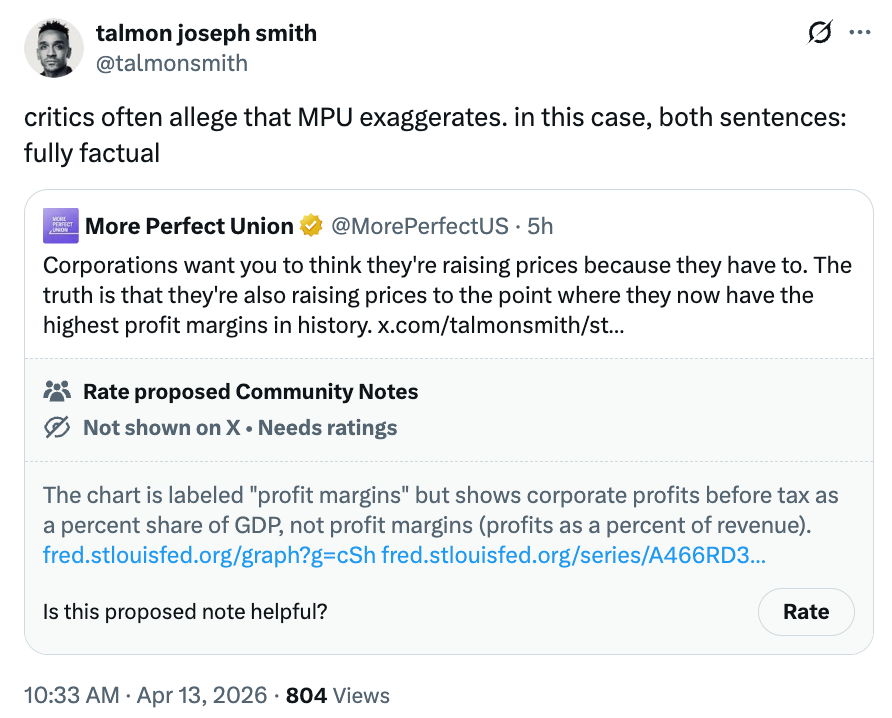
My family got to London on an airplane. The tickets we bought cost money. Obviously, I would have preferred to spend less money rather than more money. But it’s a fallacy to think that United Airlines could have just chosen to be nicer and make everyone better off by selling the tickets for less money. The flight was basically full.
The choice between “companies raise prices because they have to” and “companies raise prices because they are greedy for profits” is basically wrong in both directions. Companies do a fair amount of guesswork and use a lot of somewhat arbitrary rules of thumb in setting their prices. But the basic way the economy works is that there are big incentives to set prices high enough to avoid running out of inventory but low enough to avoid having tons of unsold inventory. Of course there are now lots of digital businesses (including Slow Boring) that have zero (or near-zero) marginal costs and where these considerations don’t apply.
But broadly speaking, the role of prices in the economy is to balance supply and demand so that if you try to go buy something, you will find that it’s for sale.
This is the point that I keep making about the “greedflation” debate.
To look at a situation where profits and prices are both rising and say that proves that prices rose because profits rose rather than because of excess demand is a mistake. After all, suppose excess demand were to blame — what would that look like?
Well, you’d have too many buyers chasing too few goods and services, so prices would go up to avert shortages. As a result, profits would rise. I keep pointing out that even though we switched from talking about “inflation” to talking about “affordability,” the thing that actually happened is that the inflation rate fell a lot in 2024 but was still above target on Election Day. Then it basically stalled out above target all last year and now has gone up again in 2025 thanks to new policy errors.
If you keep having an inflationary situation, you’ll keep having this phantom greed as a problem.
Scrub John: If, for some reason, Trump woke up tomorrow and announced “the U.S. is doing temperature in Celsius now” would he be able to make that happen?
No, this is the issue that would cause Republicans to finally abandon him en masse and he’d be impeached.
Tom H: What is going on with “far right” politics in Europe? Giorgia Meloni gets tagged with the same “far right” label as Orban, but shes pro EU/nato, anti putin, and doesn’t seem to have the same postliberal goals of her “far right” counterparts. I’ve gotten the sense that at least the US media doesn’t really understand what is going on across Europe and is struggling to communicate it to a US based audience.
The basic issue is that in postwar Europe, the main flavors of political party were Christian democratic, liberal, social democratic, and communist. Then a lot of countries also have a newer Green Party. After 1989, though, the communists started rebranding and we call the rebranded parties “far left.” You also started to see the rise of political parties on the right that have a very strong electoral focus on being anti-immigration.
Several of these parties have institutional links to old fascist parties. They came to be called “far-right,” but it’s actually not clear that they are systematically further right than other European right-of-center parties so much as just right-wing on immigration. This has then gotten mixed up with a lot of these parties adopting pro-Russian foreign-policy lines, which is definitely not a traditional right-wing stance.
Meloni is considered “far-right” because her political party has the same institutional origins as other European far-right parties. And she is very tough on immigration. But in the specific Italian context, it’s actually a different political party (Matteo Salvini’s Lega) that has the pro-Russian foreign policy.
City of Trees: Does Nate Silver’s recent assessment of Twitter match much with your recent experience on the site? And if you were in total control of Twitter, what changes would you make to make it better?
I think a lot of the problems on Twitter are downstream of the fact that Elon Musk has given himself super-user privileges and is also very irresponsible in his personal conduct on Twitter.
I don’t agree with Musk’s politics, but he’s objectively a very intelligent and capable person. And there are plenty of Twitter users whose politics I don’t agree with but who are still high-quality follows because they have sound epistemic practices. Which is to say they link to interesting studies, they express uncertainty when warranted, they correct themselves if they get something wrong, they sometimes fight with people who are “on their team,” and they generally conduct themselves like reasonable people.
But Musk himself is a terrible citizen of the Twitter community. Despite the failure of the DOGE experiment, he is still basically never linking to sound factual information about the federal budget or highlighting the work of sober-minded center-right budget analysts. He is never uncertain about anything. He’s never gotten anything wrong. He never engages in meaningful debates with right-wing figures about electric cars or solar power. He instead promotes a large network of very low-quality accounts who in turn promote other low-quality accounts.
All of which is to say that I don’t really think it’s a structural issue; in a lot of ways the structural changes Musk has made to Twitter are good. But he’s a great engineer and a shitty media personality, and the platform reflects his bad taste and poor conduct.
I do ML in my day job and was working toward an advanced degree in the field of natural language processing when the now-famous Attention Is All You Need paper released. It really was transformative for my field, and was recognized as such at the time. But I don’t think even most smart and informed people working in ML anticipated that this model architecture would produce the capabilities we see today in less than 10 years’ time. I, along with many people in the field I talk to, continue to be astounded by what these models can do, even with their limitations.
That is to say, I am skeptical there is much correlation between the depth of one’s understanding of the linear algebra techniques that undergird the transformer architecture and one’s ability to make accurate predictions about what impacts these algorithms will have on society.
We shouldn’t fall into the trap of assuming the nerds, myself included, have any secret wisdom about the future. As a group, we were wrong about the second-order effects of the internet, and I suspect those predictions were made with much more earnestness than the pitches the AI companies are making.
The center-left media refuses to admit that in much of Europe, immigrants commit crimes at meaningfully higher rates than natives. A lot of this is a composition effect — Europeans are heavily socialized and well-behaved, so admitting almost any other group will mechanically push crime rates up. Germany's 2023 police data makes the point cleanly: non-Germans are about 15% of the population but 41% of violent crime suspects, and asylum seekers specifically were roughly 2% of the population and 15% of rape and sexual assault suspects in 2017 (the pattern has held since). Yes, young-male demographics and socioeconomic status explain part of the gap — but only part.
The problem is European elites don't want to admit this. Rather than an honest discussion of the tradeoffs — more disorder versus a younger, more dynamic workforce and a shored-up welfare state — voters get force-fed pieties about equality that don't match what they see on the street. Add the fact that subsidizing unproductive new arrivals strains the welfare state rather than rescuing it, and the electoral success of the European right makes sense.