


I planned five first dates in 2025. I did not attend a single one.
Instead, I’ve taken up matchmaking in a time of dating app fatigue, pairing up my enthusiastic friends for completely blind dates. So my Zoomer friends, at least, are definitely dating, contrary to the many articles that indicate otherwise.
My own social circle is not a representative sample, of course. But last May, while reporting a story that didn’t quite come together, I spoke with a young man named Caden from central Ohio. Caden, who is currently in his first year at college, told me that he and all of his friends were actively dating or in relationships. During his senior year at his public high school, he said, “Everyone dates.”
These are impressions, not data points. But they push back against an increasingly popular narrative that itself is not well-supported by data.
What’s clear is that many of the systems that once moved people toward each other have greatly attenuated. We dismantled the social infrastructure that reliably moved people from singlehood into relationships for most of the 20th century, replaced it with technology that was supposed to fix the problem, and are only now reckoning with the fact that the fix didn’t work very well. The resulting dysfunction gets misdiagnosed, repeatedly, as a generational character flaw.
Every few months, a new round of think pieces and polls conclude that young people are not dating. Young people aren’t going on dates, aren’t forming relationships, aren’t getting married. (That last point is mostly accurate.) The implication is that something has gone badly wrong with this specific generation — that young millennials and Gen Z, uniquely afflicted by phones or anxiety or impossibly high standards or whatever your preferred cultural villain is, have simply opted out of romance. I’m not convinced.
The data problem
The hot study du jour comes from the Institute for Family Studies and Brigham Young University, which last month published a report arguing that “Today’s young adults are in a dating recession.” In its survey of 5,275 unmarried young adults between the ages of 22 and 35, what the institute calls “prime dating years,” the authors found that one in three is actively dating — which they define as dating at least once a month. This is an interesting observation, but the study has no baseline from past generations or comparisons to prior years. The concept of a “dating recession” implies that a much larger fragment of the population was meeting that “actively dating” standard in the past, but the data simply does not support that.
One of the few comparisons that does exist comes from the Survey Center on American Life. Their 2024 study found that 56 percent of Gen Z adults reported being in a romantic relationship at any point during their teen years, compared to around three-quarters of baby boomers and Gen Xers. For Gen Z adult men specifically, nearly half reported having had no relationship experience during adolescence — about double the rate for men of older generations. That’s a real gap, but those numbers are about teenagers, not the young adults the Institute for Family Studies is looking at.
The most rigorous longitudinal data comes from the Monitoring the Future survey, which has asked high school students the same questions annually since 1975. It shows that the decline in teen dating started not with smartphones but in the early 1990s and accelerated in the mid-2000s. Those responses are from teenagers only, so they, again, do not tell us anything about young-adulthood dating habits.
There’s an additional problem buried in that data. The survey asks teens how often they “go out on a date” — phrasing that may simply read as archaic to a teenager today who hangs out in their boyfriend’s basement instead of going out somewhere. (This is a more accurate account of dating when I was in high school — and, frankly, college — not too long ago.) That survey may be measuring a change in vocabulary as much as a change in behavior.
So the more defensible claim — which is itself not very defensible — is narrow: high school dating has declined steadily for 30 years. What young adults are actually doing romantically is much harder to nail down, and the researchers declaring a recession have not managed to do that.
What clearly has changed
My grandmother at 19 married a boy she had known since childhood, in the same 5,000-person Arkansas town where they both grew up. My mother left that town for high school, then boarded a bus to Massachusetts for college. My parents met after graduate school. The impulse to marry your high school sweetheart (or to marry young at all) has been declining for decades as women gained more educational and career opportunities, so of course teen relationship rates have declined along with that impulse.
Along with rising age at first marriage, there’s been a sea change in how couples meet.
Stanford sociologist Michael Rosenfeld’s “How Couples Meet and Stay Together” survey tracked how heterosexual American couples met across decades of relationship histories. Around 2013, online dating became the most common way couples meet, surpassing introductions through friends. By 2017, roughly 39 percent of heterosexual couples reported meeting their partner online, up from 22 percent just eight years earlier.
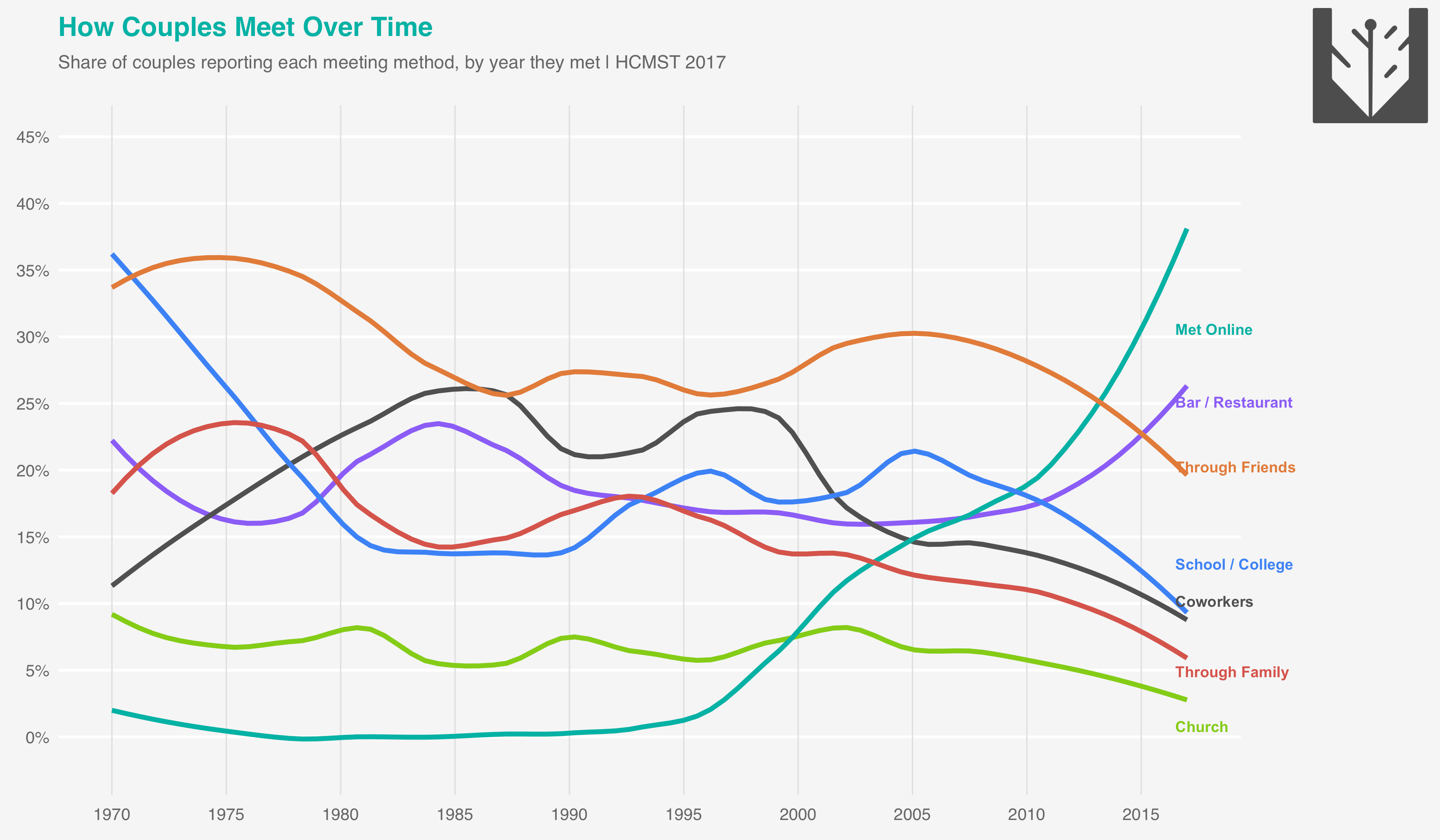
What got displaced was the entire ambient infrastructure of introduction: friends, family, church communities, neighbors, coworkers. Meeting through family connections has been declining since roughly 1940, according to Rosenfeld. Church attendance across religions has fallen for decades. Friend-mediated introductions dropped sharply after 2009 — precisely when phone-based dating apps proliferated.
Those older systems were often coercive, parochial, and deeply limiting for anyone who didn’t fit the dominant social mold. Same-sex couples adopted online dating far earlier and at much higher rates than heterosexual couples precisely because the old infrastructure failed them more completely. But those systems had one feature the apps stripped out entirely: vouching.
Your aunt’s friend had a son. You worked alongside your coworker for years. You grew up with someone you met in Sunday school. The introduction came preloaded with social context and — crucially — with accountability. You certainly did not want your aunt hearing about your indiscretions. And if you had a bad reputation, you lessened your chances of getting set up at all.
The fix that failed
Those systems broke down as young people modernized, and a new kind of dating emerged to solve for the logistical difficulty of finding a partner outside of one’s immediate social bubble. The theory behind dating apps was simple: build platforms to match people at scale, and more people will find partners. Match.com launched in 1993. eharmony followed with algorithm-based matches in 2000. Tinder arrived in 2012 with quick, high-volume swipes geared toward hookups. Hinge came out that same year with a focus on long-term relationships, promising it was “designed to be deleted.” By the 2010s, the dating app was the dominant technology of romantic search.
But the marriage rate kept falling. The share of 40-year-olds who had never been married hit a record high in 2021, according to Pew Research Center.
Scale turned out to be a double-edged sword. A larger pool of potential partners can also produce paralysis and chronic optionality rather than commitment. The platforms are also designed to keep you on them: Match Group, which owns Tinder, Hinge, OkCupid, and Match.com, was sued for allegedly gamifying their apps to make them more addictive to users. Rosenfeld found that how couples meet has no meaningful effect on relationship quality or longevity once they’re together, and meeting online has not increased the rate at which people are pairing off, either.
But is being on a dating app, and making the effort to swipe on people and strike up conversation, considered actively dating? If it is, then young people are absolutely dating. But it depends on one’s definition, which the Institute for Family Studies does not outline clearly.
The apps also stripped out the vouching mechanism entirely. A profile is not a recommendation. Evaluating a stranger’s self-curated highlight reel, which might include a school, a job, and a prompt answered with calibrated wit, is a low-information process compared to what your friends could tell you. And without the social embeddedness of the old system, there is no accountability structure.
Dating apps tried to correct the superficiality with profiles and prompts. Hinge’s original pitch, before it was acquired by Match Group, was explicitly that it would show you friends-of-friends. That framing was largely abandoned as the app scaled.
The old system carried less risk. The new system demands continuous, effortful self-marketing, and has produced winners and losers in ways the old system did not. A small percentage of highly attractive, highly photogenic, highly copy-literate people thrive, while a much larger group churns through matches without success. When a system fails you repeatedly, the rational response is to disengage. That disengagement is part of what the Institute for Family Studies is calling a dating recession.
I have set eight friends up on blind dates. (None have resulted in a relationship yet, but the effort was there.) What strikes me, doing it, is how much implicit knowledge it requires. I have friends who look great on paper but who I wouldn’t set up. I have other friends who strike out on apps but who I think are genuinely exceptional and would set up without hesitation. The knowledge that makes a good match isn’t legible to an algorithm. Just ask Celine Song.
The next experiment
The dating app industry seems to be circling back to the vouching problem. A start-up called Cerca, which launched primarily in New York and on university campuses, is built around matching people within their existing social circles by importing contacts, surfacing mutual connections, and letting people vet dates by texting friends in common. Frnds of Frnds does something similar. A service called Blindmate inverts the whole model, inviting friends to set up their friends by contributing to profiles and endorsing matches, with photos only revealed as a conversation develops.
These are small experiments — Cerca has around 60,000 users, against Tinder’s hundreds of millions. But they represent a coherent theory that what failed about the first generation of dating apps wasn’t technology per se, but the specific choice to optimize for scale at the expense of the private information provided by social context. If that hypothesis is right, then the dating recession narrative gets the diagnosis backwards. The problem is not that young people have lost interest in relationships. The system designed to help them find those relationships was built on a flawed premise from the start and is now being seriously reconsidered.
Without comparison, I don’t buy the “dating recession.” The shift that is occurring is less about a generation’s willingness to date and more about the collapse of the infrastructure that used to move people toward each other on the basis of tacit knowledge rather than marketing.
Weekend letter of recommendation:
I am currently reading “Murderland” by Caroline Fraser and finding it hard to put down. Fraser’s descriptions of the Pacific Northwest and her mapping of sinister threads throughout both its history and geography are captivating. I’ve learned a lot that I didn’t previously know about lead.
“God Is in the Algorithm” by Daniel Falatko for the Metropolitan Review is an excellent essay about the rapper NBA YoungBoy, whose numbers are up there with Drake and Taylor Swift, but with whom you, like I, might not be familiar.
This is music of an incredibly interesting tradition: absurdly popular but completely misunderstood, and even hated, by critics and legacy media outlets, and therefore largely unknown to anyone outside of the artist’s core demographic despite the music’s huge reach and success.
Set someone up on a blind date. Make a reservation at a cocktail bar or a restaurant and send two (willing and open-minded) friends there without any other information.
Whole Foods sells oysters 12 for $12 on Fridays. Get shucking.
I agree somewhat with this take, but I suspect there’s also a large part being played by the availability of tech at home.
Simply put, for many people (especially young men) there’s no reason to leave the house when infinite video games, streaming, and pornography are right at home with you.
So I do think some part has to be played by a decreased willingness to date and take risks, when the attractions of staying at home have never been stronger. I’m more willing to believe in a real “dating recession” caused by these dynamics. More data would help a lot!
I'm directly responsible for matchmaking between friends that led to two marriages. One couple even named their first child after me (I had long been requesting 10% of their wedding gifts as a finders fee, but the whole name thing makes up for it). The other marriage is now in the process of dissolving, rather acrimoniously, so matchmaking isn't necessarily the key to a perpetuity of happiness.