

When you’ve finished reading today’s post, I hope you’ll check out the latest episode of “The Argument” podcast, where Jerusalem and I explore Hannah Arendt’s “The Human Condition” and what artificial intelligence could mean for everything from the future of work to the purpose of human life. Paid subscribers can watch or listen ad free and read the transcript and show notes here. If you’re a free subscriber, you can catch the episode on YouTube here or listen wherever you get your podcasts.
Subscribe: Apple Podcasts | Spotify | YouTube | Overcast | Pocket Casts
Arguing about electoral politics is annoying at times, so I thought today it might be more fun to go back into “One Billion Americans” mode and uncork some policy takes about how I think everything ought to work.
Before we begin, I want to acknowledge that one way in which I’ve become more politics-brained over the years is in recognizing that at a certain level of detail, it doesn’t make sense to hold too strongly to your policy opinions.
I believe my April take that dogs aren’t people has largely stood the test of time. But in the course of expressing the view that dogs and humans are different in politically and morally relevant ways, I got a little cranky about dog parks. And I don’t think what I said about that in particular really holds up. I don’t own a dog, so I don’t care about dog parks, and if it were totally up to me, I probably wouldn’t build any. But I don’t play pickleball either and yet we have pickleball courts. It’s fine if I’m outnumbered and people want to build recreational facilities I don’t personally use. Tastes differ and that’s okay.
So, some of the ideas below are going to be — deliberately — a little vague because I think a certain amount of vagueness is appropriate. We have a pluralistic democratic society, and there’s never going to be one totally definitive way to do things.
Still, I think we can say a few things about the United States pretty clearly:
The U.S. is a rich country with relatively poor public-health outcomes given our prosperity. The material living standards of the poorest Americans are shockingly bad given the overall high living standards. Health care has a lot of problems, but trying to fix them requires that we pay attention to a lot of fussy technical details. Housing, on the other hand, presents a lot of problems that are quite straightforward and relatively simple. Our long-term budget problems, which everyone’s grown bored of hearing about over the years, are in fact not so “long-term” anymore and need to be dealt with. We need to make policy in the national interest, but that interest is best advanced through openness to the world and especially through collaboration with other open societies.
Now, on to the takes.
Helping those in need
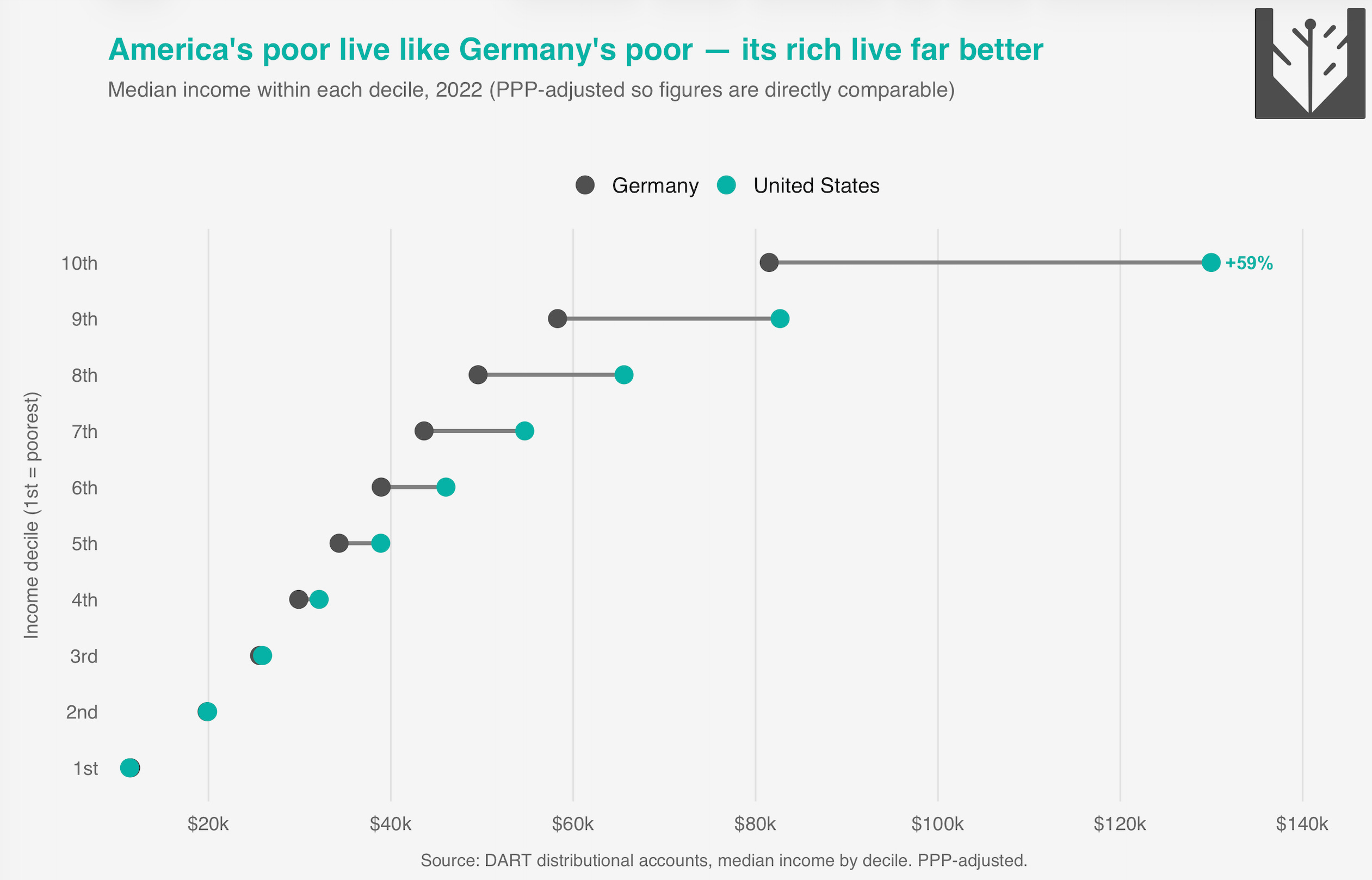
While the U.S. is a lot richer on average than, say, Germany, it’s still the case that poor Americans are worse off by many measures.
The simplest fix is to give unconditional cash benefits to kids (in effect, to their parents). The most politically expedient way to do this is to make the program relatively cheap by having an income phaseout. But I think the best way to do it is not to characterize this as a targeted anti-poverty program but as a universal transfer from non-parents to parents, just like public schools.
This should probably feature a big one-off payment when a kid is born (a “baby bonus”), followed by generous monthly payments for the first year (“paid leave”), then somewhat less generous payments for the next few years (a “child care subsidy” or a “home care allowance,” depending on what you do), then further reduced payments when the kid reaches school age. Finally, it should phase down for older teenagers on the expectation that they can get part-time jobs (with some provision made for disability and other relevant considerations).
To do this at reasonable payment levels would be incredibly expensive, but I think it makes a lot more sense on the merits than the current smorgasbord of family policy ideas that Democrats are proposing. And it scales up or down smoothly — you could do it just for kids under three and still accomplish a lot and then work for expansion to older kids over time.
The other big thing in this bucket is medical care.
Medicare for All has become this endless factional discourse object that only serves to make people angry at each other, but there ought to be a system whereby everyone can get free or nearly free health care at government expense.
This should be financed with a value-added tax, which would be progressive relative to the existing structure of health insurance premiums but also relatively efficient. The idea is that consumption of “stuff that is not health care services” would pay to subsidize a free tier of health care services. How high should the VAT be? How generous should the free tier be? I don’t think these questions have definitive answers; experts and voters will argue and go back and forth. Since this is a wealthy country, we should expect that most people will supplement with out-of-pocket purchases or private supplemental insurance. And we should also acknowledge that health outcomes are only very partially about health care services. But there is some sense of “necessary and useful medical care” that everyone should be able to get and that is provided by the public, just like roads and parks.
A healthier country
A lot of what makes life in America tough for the poor compared with life in other developed countries is that Americans — and especially low-income Americans — are exposed to a lot of violence. Beyond the lives and money directly lost to murder, robbery, and reckless driving, a tremendous amount of time and resources is wasted on avoiding these problems. Big strides have been made against crime over the past 30 years, but it’s still the case that the most dangerous city in France has a lower murder rate than low-crime rural states like Montana or Nebraska.