


Everyone likes to talk about “elites,” but what does that mean? Or what do people even think it means?
This week, Jerusalem and I discuss interesting polling from The Argument that asked Americans who they think the elites are. The answer is primarily the very rich, followed by celebrities and to a lesser extent business executives and elected officials.
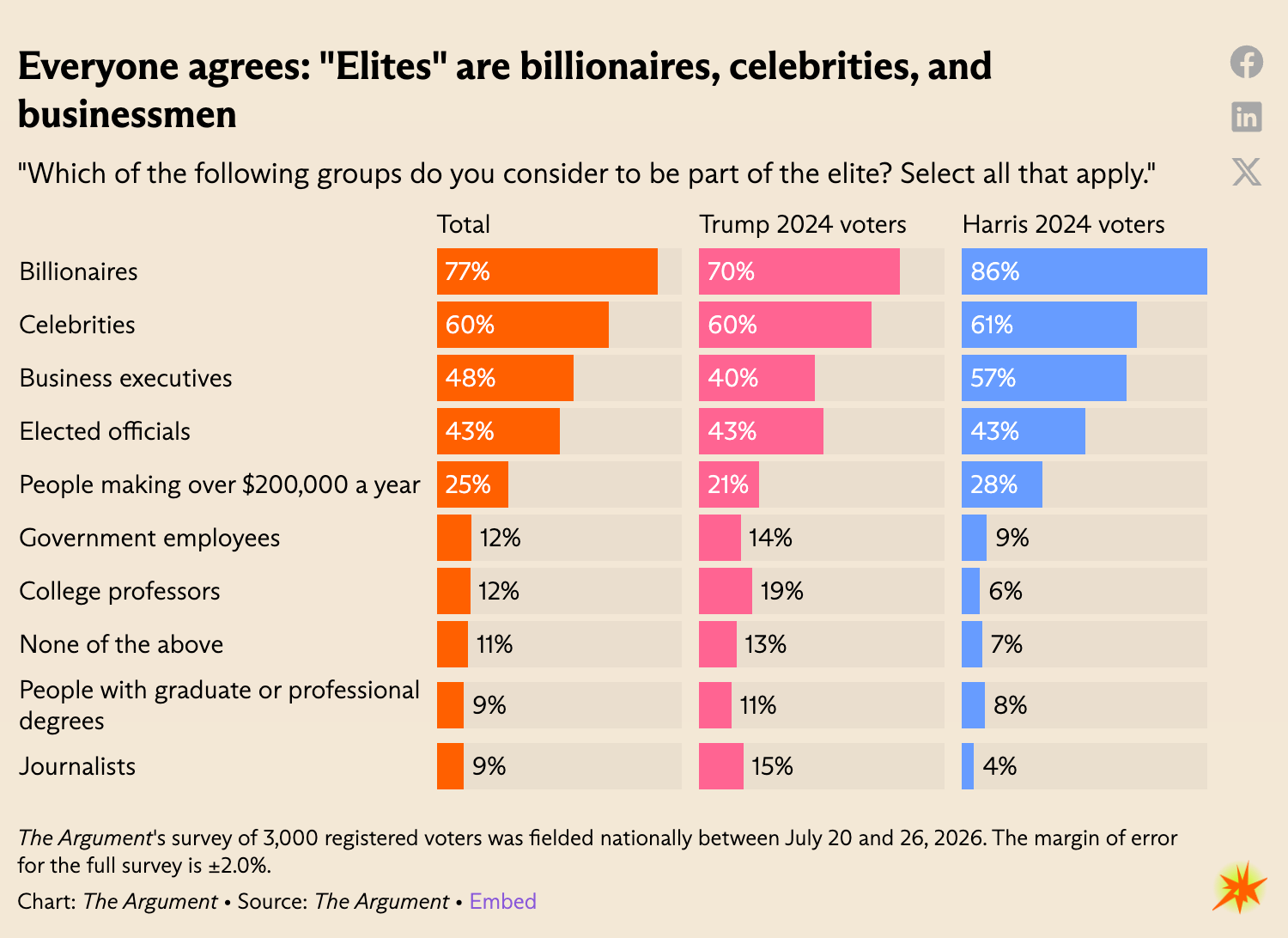
The mass public largely rejects the conservative concept of an intellectual elite composed of professors, journalists, and people with advanced degrees and seems more aligned with the left-populist concept of anti-elitism as basically just hostility to rich people.
One point I raise is that the “celebrity” category may resolve some of the disjuncture here. After all, a famous and successful journalist or professor can shade into the celebrity category and therefore become elite. Certainly if what you’re interested in is social and political influence, then a famous journalist seems more elite than a similarly famous actor, athlete, or musician — while stipulating of course that the most famous actors, athletes, and musicians are much more famous than the most famous journalists.
My strongest disagreement with the voting public, though, is about its emphasis on the elite status of billionaires relative to business executives.
Of course, many billionaires are business executives and many business executives are billionaires. But to the extent that these categories become disjointed, I think someone like Walmart C.E.O. John Furner is a very important actor in American society even if his net worth is “only” in the low nine figures. To me, the whole point of a concept like “elite” is precisely to distinguish the idea of prestige and influence from mere wealth. Walmart founder Sam Walton’s grandson Lukas is a lot richer than the company’s present-day C.E.O. I’m happy to call him part of the elite just on the basis of his wealth, but, in practical terms, fewer people care what he thinks than pay attention to the views of Furner and other hired-gun C.E.O.s of major companies. Similarly, I would say that senators and four-star generals and admirals are absolutely part of the American elite despite receiving relatively modest compensation. What is the point of the term if not specifically to draw this distinction?
We also delve into some interesting findings about what most Americans believe the elite believes. Jerusalem notes that voters seem to perceive elites as disagreeing with them about basically everything. So most people believe in a government guarantee of health insurance and believe that elites do not support this. But most people oppose government ownership of most businesses, with a larger share saying that elites support the policy. Similarly, Americans believe that elites are against free trade and hold more traditional views about gender roles.
Jerusalem and I discuss all this and more, including the important question of whether we are elites.
Paid subscribers can watch the ad-free embedded video at the top of this post and read the full transcript below.
WATCH THE EPISODE ON YOUTUBE HERE
New episodes post every Thursday.
Listen to this episode with a 7-day free trial
Subscribe to Slow Boring to listen to this post and get 7 days of free access to the full post archives.


