

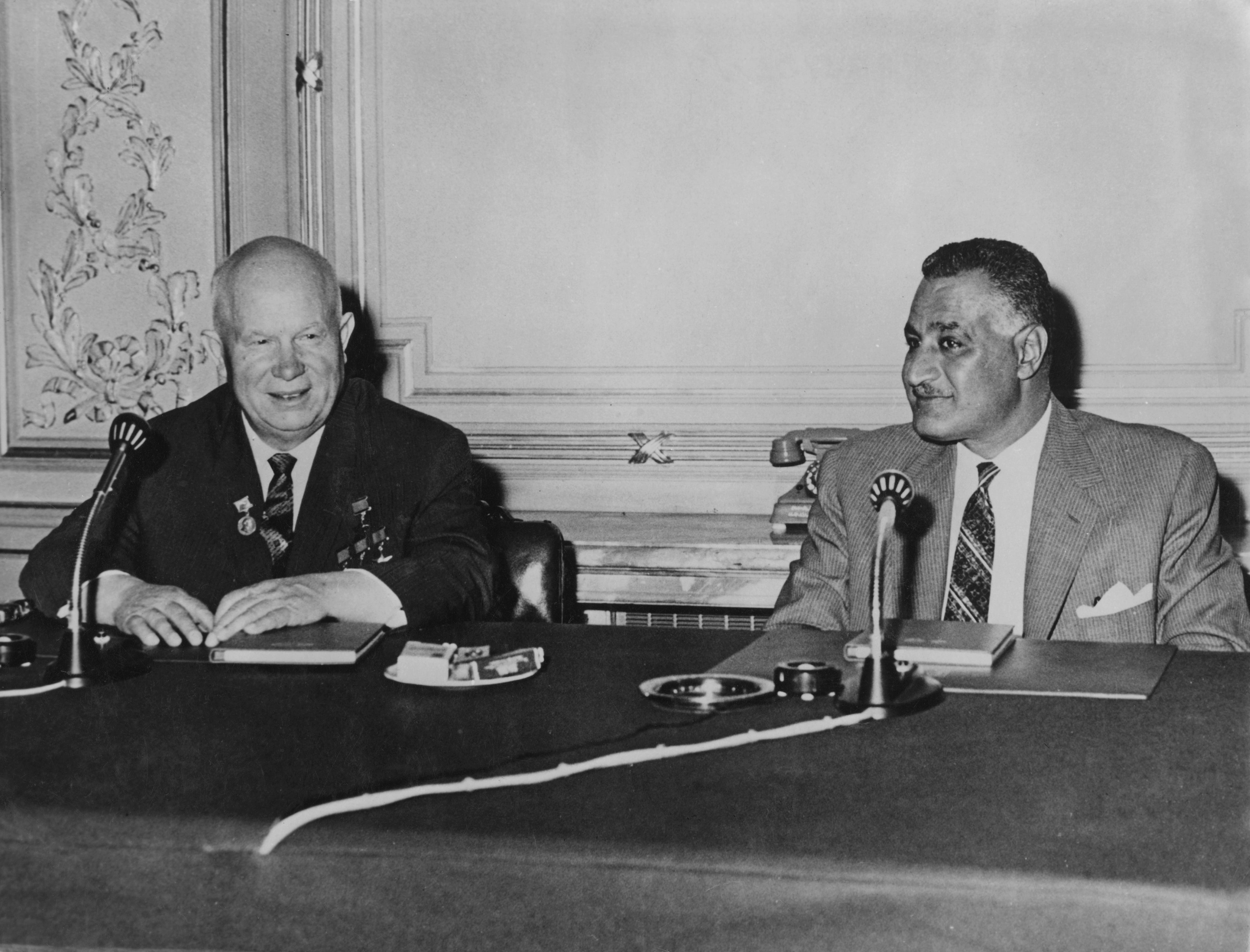
For today’s post, as a bit of a break from the news cycle, I wanted to think through an alternate history scenario involving a world leader who tried something dramatic that worked in the short term but unambiguously failed to achieve its goals in a broader sense.
An idea that seemed to fit the bill was Dwight Eisenhower’s handling of the Suez Crisis of 1956. This is a bit of an obscure episode. To summarize briefly (we’ll discuss more later), a new Arab nationalist government came to power in Egypt led by Gamal Abdel Nasser. Nasser, as an Arab nationalist, was supporting the revolutionary movement in Algeria and also backing forces in places like Iraq that were hostile to existing regimes aligned with British oil companies. This brought him into conflict with the governments of Britain and France, and in turn he was cozying up to the Soviet Union. He tried to get Western financial support for the Aswan Dam project, but was denied. So he decided to nationalize the Suez Canal, which at the time was operated by a private company owned by British and French investors. The United Kingdom and France responded by teaming up with Israel to invade Egypt.
Eisenhower was afraid that this would radicalize Arab public opinion against the West and push them all into the arms of the Soviet Union, so he leaned hard on the invaders to abandon the project and let Nasser seize the canal. He threatened to tank the British currency, signaled the U.S. would not cushion the Europeans from the economic fallout, and otherwise made it clear that the U.S. was all in on forcing its closest allies to reverse course.
This worked in the sense that it got them to withdraw. But the strategic goal of getting Nasser to align with the U.S. didn’t work at all. His prestige in the region rose, he took Soviet financing to build the dam and became a major purchaser of Soviet arms, and he would later unify Egypt with Syria. The U.S. then ended up backing Israel versus Egypt in the Six Days War and the Yom Kippur War, with Egypt squarely aligned with the Soviet Union.
Given that siding with Egypt didn’t achieve what Eisenhower wanted, it seems natural to ask what would have happened if he’d just been more chill and said this was between Egypt, the U.K., and France?
Historians like Ike
As I read more about this, I was interested to learn that the conventional wisdom among historians seems to be that Eisenhower did the right thing here.