

Apple has a new C.E.O. this week (John Ternus), and I have an oddly specific favor I’d like to ask of him: Let kids of all ages load digital mass-transit passes onto their Apple Watches instead of the current weird rule where you have to be 13 to do this.
For eight years, starting at the age of three, my son attended the neighborhood public elementary school that’s literally one block from our house. From a basic transportation-logistics standpoint, we absolutely could not have asked for a better arrangement, and even after he was clearly old enough to walk himself to school, I still liked to walk with him in the mornings and chat with other neighborhood parents at drop-off.
Last month, though, he started middle school.
A new neighborhood middle school is slated to open in 2028, but it’s currently 2026, and so for the purposes of my son’s middle school career, our “neighborhood” public middle school is located across town.
This naturally raised the question of how he and his peers were going to get to school. One option, obviously, is that Kate or I could drive him. And a lot of parents do that.
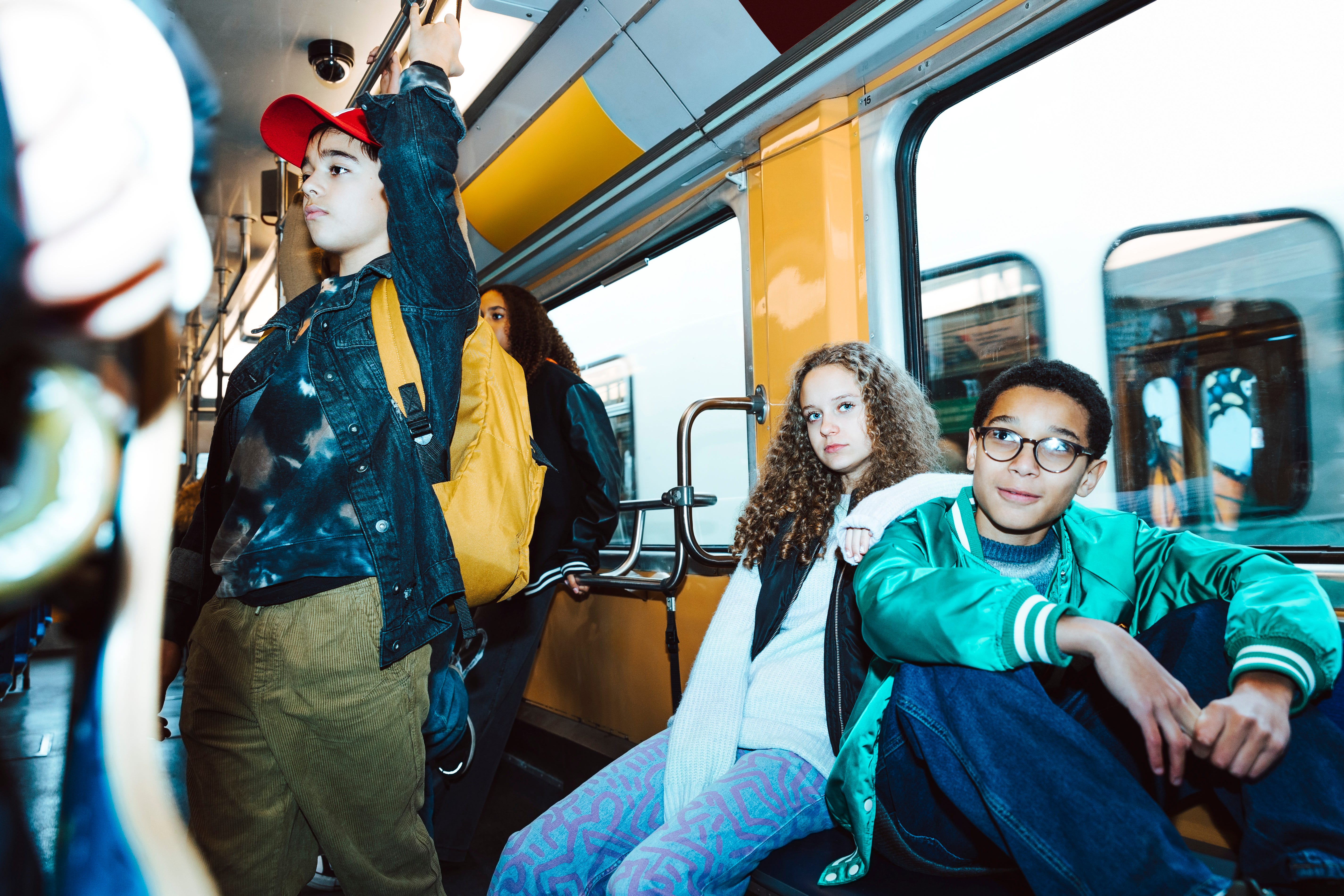
But the school isn’t in the direction of our office, which we chose in large part because it’s walking distance from our house. So we decided to take a great leap forward in child autonomy and let our 11-year-old walk a few blocks from our house to catch a city bus that drops him a few blocks from his school. In the afternoon, he does this trip in reverse.
The bus route in question runs at a low frequency. On one level this is annoying — as Jarrett Walker says, frequency is freedom. But from the specific standpoint of middle school, this lack of freedom has some upside because it means there are reliably a bunch of students commuting on the one bus that arrives right before school doors open.
Many sixth graders have smartphones these days, but we and a number of our peer parents didn’t want to go that route, so we instead opted for Apple Watches. This way our kids can text us and each other without having full, easy access to the internet and social media apps. Apple, in its wisdom, even created a special kids’ mode for watches that allows them to pair with an adult’s iPhone.
But along with various sensible restrictions, kids’ mode prevents you from loading a transit pass into a kid’s version of the Apple Wallet.
That seems crazy! Digital transit passes are an incredibly useful feature, the kids’ mode for the watch is smart, and mass transit is great for kids. But you can’t make it all work together, and that stinks.
“The bloody R.O.I.”
There was an interesting business moment back in 2014 when Apple’s then-C.E.O. Tim Cook was challenged at a shareholder meeting about why the company devoted so much effort to making their devices accessible for blind users. There are, after all, just not that many blind people in the world. What’s the company’s return on investment for that strategy?
“When we work on making our devices accessible by the blind,” Cook said, “I don’t consider the bloody R.O.I.” He then elaborated that “if you want me to do things only for R.O.I. reasons, you should get out of this stock.”
On some level, that can’t be right.
Obviously, if the cost of accessibility work escalated 100-fold, the C.E.O. of the company would have to ask whether that money was well spent. Part of the reason Cook could afford to be blasé about the exact R.O.I. on the accessibility features is that the “I” part of the equation was low.
Still, I think this was a shrewd posture, not just as external-facing public relations but as part of building a durably successful company. It’s a lot cheaper and easier to attract and retain people who do difficult and diligent work if they believe, sincerely, that their work makes the world a better place. Even if only a small share of Apple employees were directly working on features for blind people, and even if blind people were a small share of the customers, making the world a better place for those who have serious disadvantages in life is something everyone can feel good about.
My general sense as a parent is that Apple and other big tech companies have really not adopted this ethos with regard to parents and families.
You see this most obviously in the fact that the Apple hardware ecosystem doesn’t have any dedicated products for kids. The company must calculate, reasonably, given how many kids are already using their products, that the incremental sales of designing a kid-oriented device from the ground up would be a low-return undertaking, so families need to make do with software features like the Apple Watch kids’ mode.
I kind of think that this is a mistake and the tech industry underrates how much sincere enthusiasm there was about their work 10-15 years ago and how much that enthusiasm has been undercut not by adverse propaganda but by the realization that addictive video-recommendation algorithms don’t really align with society’s aspirations for itself.
Trying hard to solve real problems in parents’ lives would be one way to get the mojo back.
Transit, kids, and tech
What I really want to say about this, though, is that mass transit is an incredible unlock for older kids.
As someone who was raised in the big city by eccentric parents in the 1980s and 1990s and then went on to raise a kid in the city, I’ve always felt this is the thing people miss about moving to the suburbs.
There comes a time when children outgrow playing with toys in their big backyards or oversized basement playrooms. In a city, older children can walk around and do stuff. And mass transit is an incredible way to extend their range. I wouldn’t send my 11-year-old off alone to a totally unfamiliar location on the bus. But riding a route that he knows with other friends is a great opportunity! And some of those friends have other commutes they’re familiar with, and maybe he’ll ride with them someday and expand his comfort zone. And as his familiarity with the system grows, he’ll be able to use it more and more flexibly.
I would note that this is not really a reason to build mass-transit infrastructure in places where nobody uses it, because you probably wouldn’t want to send your middle schooler on a creepy empty bus.
What’s nice for kids is a quality transit system that attracts high ridership and has mainstream users. I don’t want to overly idealize WMATA, the capital region’s transit agency, or deny that you’ll encounter some sketchy characters on the bus. But if you ride at normal commuting times, you mostly see normal commuters. The situation on the Metro dramatically improved after a fare evasion crackdown, and since this past spring, WMATA has brought that same energy to the bus.
Because good things compound, I hope more D.C. parents read this and send their kids on transit.
But by the same token, tech products aimed at children should facilitate transit use. Obviously, most Americans do not live in transit-rich places or use mass transit regularly. But for those of us who do live in such places, riding the train or the bus is a normal thing for a kid to do. Taking transit by himself is brand new for my sixth grader, but he’s been taking mass transit with an adult since he was a baby. Being able to load your transit card into your Apple Wallet rather than carry a physical card around is a nice feature of iPhones and Apple Watches. Let the kids do it too!
Something likewise positive about "develop accessibly for blind people" is that I think it pumps the heuristic within design teams to consider the myriad ways in which a user is different than oneself. This is another benefit of your 'design for kids?' heuristic, too, I think, but more broadly applicable and likely more adjacent to median-user unforeseen upsides.
Yes, and here in Los Angeles, they should make the public transit safe for older kids to use it on their own.
That includes 1. enforcing fares, 2. removing people who use drugs, behave erratically or initiate fights, 3. enforcing trespassing rules.