

I’ve read a number of good big-picture takes on liberalism recently, of which I would especially recommend:
One thought I had upon reading each of these articles, though, is that the terminology surrounding the concept of liberalism is fraught and controversial.
There’s a longstanding tradition in the United States of simply characterizing the more left-wing faction of the Democratic Party as “liberal” and counterposing it to the moderates.
In the 1990s, Nancy Pelosi advocated for Medicare for All while opposing NAFTA and Permanent Normal Trade Relations with China, and it was normal to refer to her and her allies on those points as liberals in distinction to Bill Clinton’s moderate New Democrats. This is not only different from, but in many ways the literal reverse of, usages that would counterpose liberals to radicals or liberals to socialists or liberals to the Black Power movement.
In the American context, we have concepts like the “libertarian” and the related idea that there is a distinct “classical liberalism” that has nothing to do with the contemporary Democratic Party.
But we also have distinguished American political philosophers like John Rawls who expound a vision of liberalism that sounds very left-wing in certain respects. In Canada, the Liberals are a center-left-to-centrist party, while in Australia the Liberals are the mainstream right-wing party. In Europe, various political parties self-identify as liberal but they’re hard to map onto American politics. The former Danish Prime Minister Anders Fogh Rasmussen, for example, was from their liberal party and advocated forcefully for free markets while at the same time, on a practical level, supporting a welfare state that’s much more extensive than what Barack Obama pushed for.
My view is that American liberalism is certainly in crisis and has crashed but, contra Noah, I don’t think that’s because liberals overreached.
And while I take Jerusalem’s point about the difference between a principled ideological posture and a tactical position, I think that, in practice, in the contemporary American context there is a deep harmony between liberalism and non-radicalism. Which brings me closer to Rauch’s view that liberals shouldn’t concede too much to our critics — while also thinking that we do have to do something to address the simmering currents of discontent in American life.
So to that end, this post is the first in a series on liberalism, and in it I’d like to try to lay some terminological groundwork and talk a bit about why I think what’s happening in the United States right now is specifically a crisis of the liberal center.
An ideology without a name
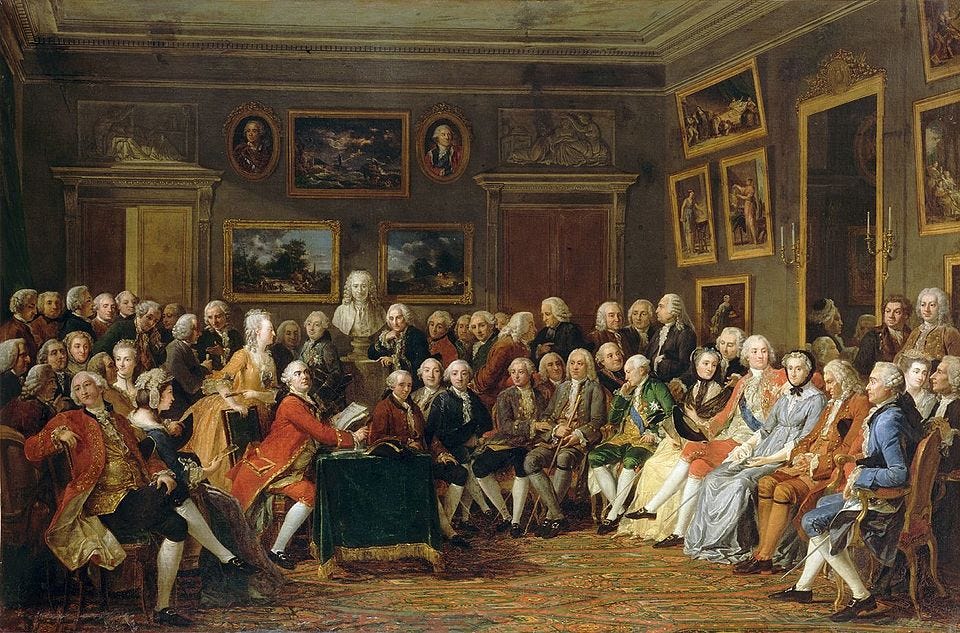
Something that perhaps can help explain the perennial state of terminological confusion around liberalism is that many of the foundational documents pretty significantly pre-date the term.
John Locke’s Two Treatises of Government are from 1689 and 1690. The American Declaration of Independence came generations later in 1776, and the Declaration of the Rights of Man came out in France in 1789. The major works in political and economic theory by David Hume and Adam Smith were published roughly between Locke and the American and French revolutions.
But even though you clearly see the origins of liberalism in the books and deeds of 18th-century thinkers, they do not refer to themselves as liberals or to their ideology as liberalism.