

Today’s Mailbag post is off schedule because we at Slow Boring wanted to get some proper Iran coverage up yesterday. That also means I skipped over a bunch of the Iran questions that readers asked.
Something I noticed while going over these questions, though, is that while I think Slow Boring readers mostly agree with me about most stuff (that’s not so surprising), one of the exceptions is that the commenters seem to be significantly more hawkish than I am.
I think this confirms that in most respects I’m a “pre-2014 Obama Democrat.” That’s in part why, at the time, I had a self-conception as fairly progressive.
In the factional arguments of the early 21st century, national security issues loomed very large and a big part of the collapse of the old Democratic Leadership Council was that they went all-in on the Iraq War and had generally hawkish approaches to national security. When Obama was president, there was lots of pressure on him — including from people inside the party — to go to war with Syria or Iran or both, and I didn’t agree with any of that. One of the things I thought Obama got wrong was his decision to side with the hawks on Libya.
Joe Biden governed to Obama’s left on basically every domestic issue, but was more pro-Israel and (even accounting for the changed situation) less attentive to the issue of Europe free riding on U.S. support for Ukraine. I don’t really agree with any of those changes. That mostly amounts to me saying “Democrats should be more moderate,” but I don’t actually want Democrats to be more enthusiastic about bombing Iran.
Person with Internet Access: Matt wrote about the failure of Keynes’ specific 15 hour work week prediction, due in large part to longer retirements and aging population, and to a lesser extent more time in education. I agree that this is the trajectory we’ve been on. But is it a good one? To me, it’s not. There are a number of reasons it seems less than ideal, not least of which, is some people get hit by a bus or get cancer and get no leisure bonus. And, if it is not, what should the government do to push to redistribute leisure time?
To spell this out a little bit more, Keynes wrote an essay in 1930 called “Economic Possibilities for Our Grandchildren” that predicted that due to productivity growth, people in the future would have radically shorter workweeks and more leisure time. The workweek is shorter today than it was 100 years ago, but not nearly as much as Keynes thought that it would be. This is often taken to show that he was dramatically mistaken about the satiation point for human consumption.
My counter is that if you look at work across the life cycle, we in fact have seen a dramatic reduction in time worked.
People spend more years in school and they spend many more years in retirement than they used to. I think that part of the reason things worked out that way rather than the way that Keynes thought is that a lot of jobs are pretty “lumpy.” If Slow Boring had two different lead writers who each did two articles per week and then we traded off doing mailbags, that would be an odd reader experience. It’s often much more convenient to have one person doing one job full-time than to split it between two people. When Keynes was thinking about this, I’m not sure he was thinking in an adequately granular way about the logistics.
That being said, there is something a little bit weird and special about retirement.
There was a good paper published back in 2012 looking at German data and asking what happens to unemployed people when they reach retirement age. Well, it turns out that they experience a large upswing in well-being. Given how the German unemployment and retirement benefits systems work out, this is not attributable to a change in their material conditions. It’s that the social identity of an unemployed person is much worse than the social identity of a retired person, and so shifting from “unemployed” to “retired” is a big win.
Someone who works part-time because he (or more likely she) has small kids is a very recognized social identity and lots of people do that or aspire to. But I think if you met a childless person who earned a high wage but only worked 20 hours a week because he didn’t value money very much and just wanted to focus on Call of Duty, you’d think that guy was a loser. If he’s spending his spare time rescuing puppies and orphans, that’s maybe a different story. But we do just kind of expect people to be busy full-time, if not by doing paid work, then by taking care of kids or family members.
And I think that’s especially true in American culture where even people who inherit large sums of money and don’t need to work tend to want to be seen as working hard at philanthropy or whatever else instead of just chilling. Keynes perhaps missed this because he’s English and, while he was living through the collapse of the gentry class in the wake of World War I, he would have grown up in a world where it was considered perfectly respectable for a gentleman to have no occupation and just live off of family money.
But, again, I think retirement shows the limits of this American culture of hard work.
If you’re affluent and in your 60s and want to stop working and just golf or whatever else all day, nobody thinks there’s a problem with that. And you can see that around 15 percent of men seem to retire early.
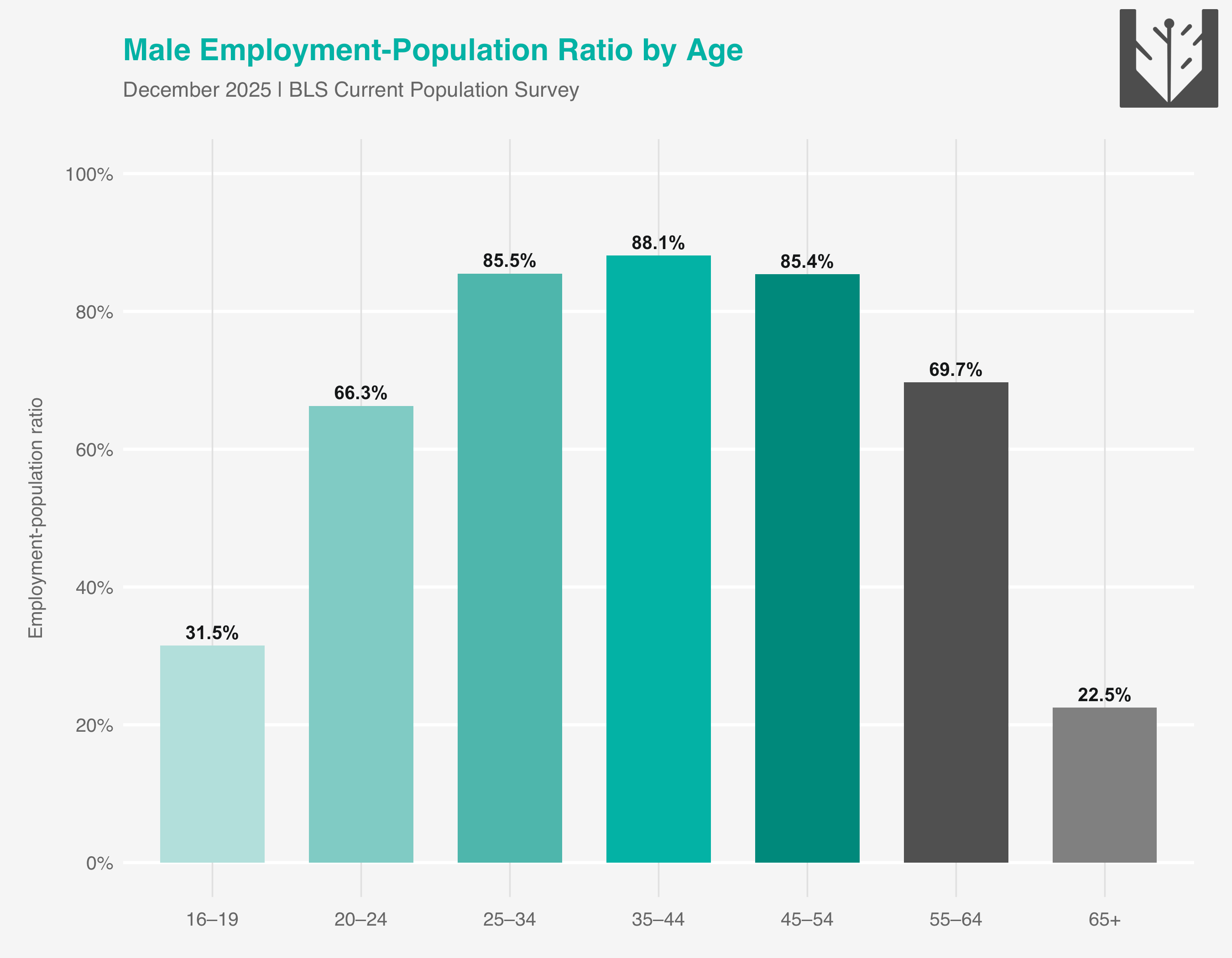
There’s definitely an aspect to this that seems non-optimal. One part is that it’s unfair to people who die young. Another is that concentrating leisure in retirement seems poorly suited to other aspects of the human life cycle like having kids.
I point to the expansion both of retirement and of full-time schooling, though, mostly to make two points:
It’s not true that “Keynes was wrong” and human lust for material prosperity knows no limits and people will just work and work no matter how productive we become.
The idea of people sitting around not working strikes most people, at least in America, as kind of depressing. But it’s clear that when you reframe it around a widely understood social identity like “retirement” that it becomes much more acceptable.
It’s at least plausible that we are on the corner of a big labor-displacing surge in productivity and while that’s something that could have a lot of downside if it’s managed poorly, I don’t want people to see it exclusively through a lens of threat. Keynes’s positive, optimistic framing of productivity growth is an important way of looking at the world.
That’s especially true because the other nuance in this leisure conversation is that a decent amount of people’s time is spent on unpaid household labor. There has been a tremendous reduction in household drudgery since Keynes’s time thanks to things like washing machines and dishwashers, even if this change isn’t easily captured in national statistics. I know a lot of people are skeptical of the upside value of artificial intelligence, but it would be pretty incredible to own a humanoid robot who would do a really good job of cleaning the house every day while you were out. That would of course have a negative implication for housekeeper employment, but thinking of it primarily in labor market terms would be a mistake — you’d be mostly replacing unpaid housework with genuine leisure.
Just Some Guy: Ok Iran stole the spotlight at the buzzer, but what should the US and/or Mexico be doing about the cartels?
This seems like a badly under-researched question to me. One of my real frustrations as a journalist is that not only does the American government expend more hard military resources than it should on the Middle East relative to the Western Hemisphere, but there is tremendous diversion of cognitive resources away from our backyard and toward countries that are on the other side of the world. If you are interested in anything related to Israel, Iran, or the Persian Gulf, it is easy to find detailed policy analyses and well-informed experts on multiple sides of the issue, learn a lot, understand different perspectives and options, and so forth.
Latin America is a content desert by comparison.
“How can the United States constructively engage the Mexican government in establishing a real monopoly on the use of force?” seems like a question that has pretty high stakes for Americans. It would easily be worth spending tens of billions of dollars on this if someone had a workable plan, but very few people are working on this topic and nobody believes large amounts of resources could be mustered for it. And it’s not a unique situation to Mexico. Across the Western Hemisphere, governments from Jamaica to Brazil and beyond are really struggling with “crime” problems that act as big millstones impeding economic growth and are at times so severe they call the stability of the state into question.
Conversely, if you think about the basic gravity model of trade, it’s clear that a more prosperous Latin America would be a really big win for the United States. These are the most natural markets for our exports of goods and services, but the ability to make a lot of money by selling things to Mexico or Jamaica or Brazil is limited by the fact that those countries are not very economically dynamic.
bill: Alternative history for Germany 1939: Invasion of Poland goes poorly. Army retreats. Hitler is humiliated prompting someone to depose or assassinate him. Germany lives happily ever after inside its August 1939 borders and is not decimated over the next 6 years.
Sounds nice! I think the standard way to put a basically similar counterfactual together is to say that if instead of the Munich Agreement, France agreed to attack Germany from the west while Hitler tried to fight through the Czech fortifications in the Sudetenland, it’s possible Hitler could have been stopped in 1938. This depends on a dozen other assumptions, though, like Hungary staying out of it, Poland being helpful to the Czechs, French public opinion actually supporting this, etc.
David Rademeyer: Do you think it’s better to believe things that are true, or to believe things that cause you to make better decisions?
I am a bona fide former philosophy major so you can’t catch me that easily — it just depends on what you mean by “better!”
Most of the time, you will make better decisions if you have accurate information. You can certainly craft situations in which the two will diverge, but in that case one set of beliefs is going to be better for one purpose and another set better for another.
Amos Karlsen: You’ve mentioned Bernard Mandeville’s writing in a previous post; do you feel a kinship with him? I feel like The Fable of the Bees, in its tone and in the pleasure it takes in laying out its for-the-time hot takes about the benefits of commerce is pretty comparable to a lot of your work.
It’s one of the great trolls of all time.
Josh Echols: Is Slow Boring ready to endorse Matt Mahan for CA governor? Seems like he is by far the most SB-aligned candidate in an otherwise shockingly underwhelming field.
Yes. I do not see this as a strategic or particularly high-leverage race and would not necessarily encourage people to use scarce small-donor dollars on it, but of the people in the field he would be the best governor. Now it seems to me that for him to make the second round, in practice he probably needs to convince some Republicans to vote tactically for him.
California uses a “top two” primary system and currently has two Republicans running strong campaigns plus a zillion Democrats. The most likely scenario is that the top two end up being one Republican and one Democrat and then whoever the Republican is gets crushed. The smarter play for conservative-minded voters is to vote for Mahan, so California can get a moderate reformist governor. But I also don’t think I have the right profile or audience to really make that case. In any case, Mahan seems like a guy who is very much in line with the Common Sense Democrat Manifesto.
Jeff: What are the primary reforms that are still needed in the healthcare space? Obamacare definitely helped on several issues, but costs continue to be too high. The most obvious abundance pitch might just be something like ‘more doctors from India’, but are there good reasons to believe that would tackle the majority of the issue? If not, what else? Regarding the uninsured rate, how do we get the remaining holdouts to expand medicaid? And trying to bring back the penalty seems like political suicide, so anything there or just benignly neglect it?
Great question. I keep meaning to write about this, but it really does seem to me that Republicans should reconsider their opposition to the individual mandate.
They appear to have given up on repealing the part of the Affordable Care Act that provides subsidies to income-eligible people to buy insurance. And they are under a lot of pressure from both Democrats and public opinion to make those subsidies more expensive by permanently extending the Biden-era enhanced subsidies.
Back when Mitt Romney was governor of Massachusetts, he understood that once you accept the premise that the state is going to guarantee care to those who need it, you actually get an outcome conservatives like better if you use a mandate to broaden the risk pool and bring down the unsubsidized cost. The logic of that position is undefeated, and if Trump embraced it he could use his cult-like control over the MAGA movement to sell it.
The way to get the remaining holdouts to expand Medicaid is, I think, for Democrats to try harder to win elections.
We have a great proof point in Louisiana of former Governor John Bel Edwards winning the gubernatorial race as a Democrat, delivering Medicaid to hundreds of thousands of poor people, and greatly improving the school system. He ought to be seen as a hero. It’s a kind of sickness of the Democratic Party and the center-left ecosystem in general that he’s not. It’s no secret why. He was super-duper conservative on certain issues — notably guns and abortion and fossil fuels — that are very important to progressive elites. He wasn’t “moderate” in the Matt Mahan sense of “says a lot of stuff Matt Yglesias agrees with.” He was “moderate” in the sense of “like most voters in Louisiana he’s way more conservative than Matt Yglesias.”
That’s what politics is, though. There wasn’t — and isn’t — some universe in which a fierce champion of abortion rights is winning statewide in Louisiana. But there is a universe in which culturally conservative Democrats win — or at least plausibly threaten to win — races in Mississippi and Alabama and South Carolina and either expand Medicaid or else put meaningful pressure on Republicans to move to the center on this.
The larger point, though, is that we need an agenda that goes beyond these insurance coverage questions and gets at the underlying drivers of cost and scarcity. Lawson Mansell is doing great work for Niskanen on health care abundance mostly focused on the basic delivery of medical services, and there’s a related push from the Institute for Progress for clinical trial abundance so that we can invent more and better cures faster.
awar: How big a deal was AOCs flub in Munich for her future political prospects? The far Right was all over her but in general commentators don’t see it as that big a deal. But in a presidential primary, with a highly educated Democratic primary electorate, someone who hasn’t done their homework or is not particularly intellectual could be seen as a real draw back.
Just on the pure politics, I think not really caring about foreign policy is a plus.
In principle, though, I think it would be good for the president to be well-informed about world affairs.
Neeraj Krishnan: Nicholas Decker here analyzes recent research on subsidizing bus rides.
The counterintuitive result is to combine road taxes with nearly free transit.
We often urge the public and politicians to grasp Econ 101 principles like ‘there is no free lunch’ or ‘Price = Marginal Cost.’ Yet, as seen in this research, the ‘optimal’ policy can be the opposite of the 101 intuition, near-zero prices to solve for external costs like congestion and pollution.
The problem is worse, the mathematics used (partial derivatives, lagrangians, generalized method of moments, etc.) is beyond high school mathematics that most citizens may be fluent in.
Should the teaching of Econ 101 change? Should citizens get training in empirical methods over ideology?
In this case, I think that normal people are in fact correct to be skeptical of an argument that relies on complicated mathematical models. I would strongly advise people to make their first cut at thinking about policy issues to be about trying to understand and imitate best practices.
There are lots of areas of life where that isn’t going to work. There are no “best practices” for regulating artificial intelligence or for manufacturing small modular nuclear reactors in factories. These are things that seem important and areas where policymakers need to try to innovate. But across all American cities, only hyper-dense and very large New York has a high share of public-transit ridership by global standards. And New York, by international standards, has very high operating costs, spectacularly high capital costs, and very poor commuter rail and bus performance. The primary task for all American transit planners should be to try to see what they can do to bring their city into closer alignment with how mass transit works in other places where it works better and is more broadly useful. There is simply no major mass-transit system in the world that works on the basis of free buses.
Some of that is that it is a relatively poor use of funds compared to investing in better transit service.
Some of that is that the world’s best transit systems have fare integration, which doesn’t work if the bus is free.
Some of that is that it is outside the scope of the model Decker cites to consider that free transit turns the bus into a kind of mobile homeless shelter that people won’t want to ride.
I am open to the possibility that someday Seoul or Stockholm or Shenzhen or some other significant city with a robust culture of high-quality mass transit will move to a free bus model and it’ll be a huge success. The buses will probably be self-driving and have much lower operating costs and there will maybe be undercover cops stationed in a random subset of them to maintain order. I don’t know. But the point is that we know which cities have good mass transit and American cities should try to copy them.
“I don’t want Democrats to be more enthusiastic about bombing in Iran” is almost a perfect summary of my frustration with Fetterman. I truly feel Manchin took too much shit for his stance but I feel like his brand of moderation was almost picture perfect considering the consituency of West Virginia but when it comes to Fetterman, his brand of moderation feels very misguided.
Like him being very enthusiastic about bombing Iran feels like an unwise moderation that bleeds support from base for almost nothing in exchange…
Countries not understanding their near neighbours is a common problem. Britain similarly spends lots of its elites' time and energy on the Middle East, as well as following US politics and topics of global concern (eg climate change, development aid etc). But European affairs is so poorly regarded we essentially Brexited by accident, and then spent years in torturous negotiations with the EU because we don't understand how the EU functions or what parts of the relationship are valuable.
Similarly my understanding is that post-Soviet states were a low status desk for Russian diplomatic and intelligence officials prior to 2022, and this low investment contributed to poor quality information feeding up into the top of decision-making over the past decade or so.
My theory is that there's a combination of elites believing they understand nearby countries inherently without having to do much work or invest much in it, and them learning the language of their near neighbours doesn't provide the same payoffs as learning/speaking English or something more exotic. A world where more top British politicians spoke French and German, more top US politicians spoke Spanish, and more top Russian officials spoke Ukrainian and Kazakh is probably a better one.